Sacramento’s SSD Superstars: Top Lawyers for Your Disability Claim

best social security disability lawyers near me sacramento ca

Why Finding the Right Sacramento SSD Lawyer Could Make or Break Your Claim

Finding the best social security disability lawyers near me sacramento ca can be the difference between approval and denial when a disabling condition prevents you from working. The application process is notoriously complex, denial rates are high, and navigating it alone puts your financial future at risk.

Here’s the reality: more than 60% of initial Social Security Disability applications are denied. This isn’t because most people don’t deserve benefits—it’s because the system is designed to be stringent, technical, and unforgiving of mistakes.

When you’re already struggling with a disability, the last thing you need is to fight a bureaucratic battle alone. A skilled Sacramento disability lawyer knows how to steer these challenges. They understand what local Administrative Law Judges look for, how to develop compelling medical evidence, and how to present your case in a way that gets results. Many experienced attorneys report success rates of 80-90% or higher—dramatically better than going it alone.

Crucially, Social Security Disability attorneys work on contingency, meaning you pay nothing unless you win. The fee is capped by federal law at 25% of your back pay or $7,200, whichever is less.
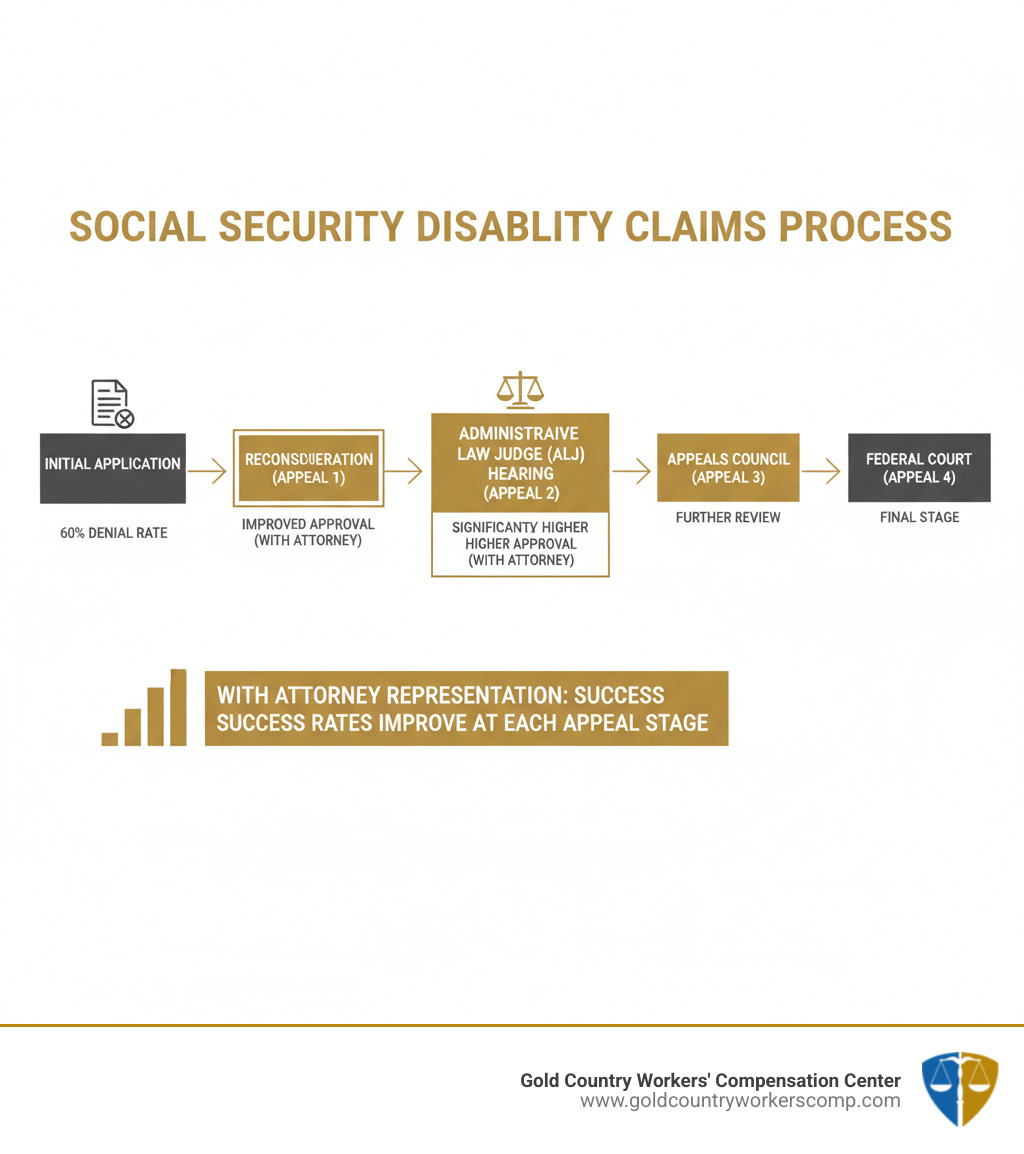
infographic showing social security disability claims process with 60% initial denial rate, appeal stages including reconsideration, administrative law judge hearing, appeals council, and federal court, with success rates improving at each stage with attorney representation - best social security disability lawyers near me sacramento ca infographic

Best social security disability lawyers near me sacramento ca definitions:

Understanding the SSD Landscape: SSDI vs. SSI

If you’re searching for the best social security disability lawyers near me sacramento ca, understand which program you’re applying for. The Social Security Administration (SSA) runs two main disability programs: Social Security Disability Insurance (SSDI) and Supplemental Security Income (SSI). Both provide financial support, but they have completely different eligibility rules. Applying for the wrong one can cause significant delays or denial.

Key Differences in Eligibility

Think of SSDI as an insurance policy you’ve paid into through Social Security taxes while working. Your eligibility depends on earning enough “work credits.” The number of credits you need is based on your age when your disability began.

SSI is a needs-based program for people with disabilities who have very limited income and resources, regardless of their work history. To qualify, your financial situation must meet strict federal guidelines.

Both programs share a core requirement: your disability must be severe enough to prevent you from performing Substantial Gainful Activity (SGA). This means your condition stops you from doing your previous job or adjusting to other work, and it must be expected to last at least 12 months or result in death.

Which Program is Right for You?

Your work history is the primary factor. If you’ve worked and paid Social Security taxes, SSDI is likely the correct program. If you have limited income and assets, SSI may be the right fit. It’s also possible to qualify for both programs simultaneously, which are known as “concurrent benefits.”

Getting this right on your application is challenging. An experienced lawyer can evaluate your work history, income, and resources to ensure your application is positioned for the best possible outcome from the start.

Criteria Social Security Disability Insurance (SSDI) Supplemental Security Income (SSI)
Funding Source Social Security taxes paid by workers, employers, and self-employed people General tax revenues (not Social Security taxes)
Eligibility Disabled, with sufficient work credits from past employment Disabled, blind, or aged (65+), with limited income and resources
Work History Required (based on age and disability onset) Not required
Financial Need Not based on income/assets (beyond SGA limits) Based on low income and resources
Associated Health Benefits Medicare (after a waiting period) Medicaid (typically immediately upon approval, depending on state)
Benefit Amount Varies based on lifetime average earnings Federally set, can be supplemented by state (e.g., California)
Family Benefits Possible for dependents Generally not available for family members (except eligible spouses)
Typical Applicant Individuals with a work history who can no longer work due to disability Low-income individuals with disabilities, or aged, or blind
Application Process SSA website, phone, or in-person SSA website, phone, or in-person
Appeals Process Reconsideration, ALJ Hearing, Appeals Council, Federal Court Reconsideration, ALJ Hearing, Appeals Council, Federal Court

The Social Security Disability Process in California

The path to getting Social Security Disability benefits in California is a marathon, not a sprint. Understanding the journey ahead—and its common pitfalls—can make all the difference.

The process begins with your initial application, filed online, by phone, or in person. This is where you provide comprehensive details about your medical condition, work history, and daily limitations. After you file, the initial decision typically takes three to six months.

Unfortunately, more than 60% of initial applications are denied. A denial is not the end of the road. It’s the start of the appeals process, which includes several stages:

  1. Reconsideration: A new SSA examiner reviews your case.
  2. Administrative Law Judge (ALJ) Hearing: This is a critical stage where over 50% of claims that reach this level are approved.
  3. Appeals Council: A review of the ALJ’s decision.
  4. Federal Court: The final stage of appeal.

Each stage is another chance to strengthen your case, but it also adds significant time to the process.

flowchart illustrating the social security disability application and appeals process - best social security disability lawyers near me sacramento ca

How Long Does the SSD Process Take in Sacramento?

Patience is essential. While an initial decision takes a few months, the appeals process can stretch the timeline considerably. An ALJ hearing, for example, can add 12 to 18 months or more due to backlogs. From start to finish, a case can take anywhere from several months to over two years.

The key takeaway? Don’t give up after an initial denial. Persistence pays off, especially with an experienced legal guide.

Common Reasons Your Claim Might Be Denied

Understanding why claims are denied can help you avoid common mistakes:

  • Missing medical records: The SSA needs complete, detailed medical evidence from your doctors to approve a claim.
  • Not meeting the definition of disability: The SSA may decide your condition isn’t severe enough or that you could perform other types of work.
  • Earning over the SGA limit: If you’re working and earning more than the Substantial Gainful Activity (SGA) threshold, the SSA will assume you are not disabled.
  • Not following doctor’s orders: Failing to follow prescribed treatment can lead the SSA to believe your condition isn’t as serious as you claim.
  • Application errors: Simple mistakes or incomplete forms can sink your claim before it gets a fair review.

Working with the best social security disability lawyers near me sacramento ca is crucial for avoiding these pitfalls and building a strong case from the start.

How a Top Sacramento Disability Lawyer Can Win Your Case

While the initial 60% denial rate seems daunting, the odds improve dramatically with an experienced disability lawyer. Many attorneys report success rates of 80-90% or higher. This isn’t luck—it’s the result of expertise and strategic case building.

A top Sacramento disability lawyer acts as your advocate and strategic partner. While non-attorney advocates can represent you, a licensed attorney has comprehensive legal training and can represent you at all levels of appeal, including federal court.

Your lawyer will start with a thorough case evaluation, identifying and strengthening potential weaknesses. They handle all communication with the SSA, manage deadlines, and work to maximize your back pay. Most importantly, they represent you at hearings, using their legal knowledge to build a winning case.

The Critical Role of Medical Evidence

The SSA requires objective proof of your disability. A lawyer is invaluable in this area, as they know exactly what kind of medical evidence is needed and how to obtain it. They work with your doctors to develop comprehensive records that paint a complete picture of your condition and its impact on your life.

This includes seeking detailed opinions from your physicians about your specific functional limitations—what you can and cannot do. Your lawyer translates complex medical information into terms the SSA understands, drawing a direct line between your diagnosis, your symptoms, and your inability to work.

For more information on how the SSA evaluates claims, visit the Social Security Administration’s Disability Benefits page.

The ALJ hearing is often the most critical stage of the process and where many cases are won. Your lawyer’s role here is indispensable.

  • Preparation: They will thoroughly prepare you for your testimony, helping you clearly articulate how your disability affects you.
  • Cross-Examination: The ALJ often calls on medical and vocational experts. Your lawyer will cross-examine these experts, challenging opinions that don’t align with your actual limitations.
  • Local Knowledge: Experienced Sacramento attorneys are often familiar with local ALJs and understand what they look for in a successful case.
  • Legal Argument: Your lawyer will present a compelling legal argument, tying all the evidence together to prove you meet the SSA’s strict definition of disability.

lawyer and client reviewing documents in an office setting - best social security disability lawyers near me sacramento ca

Your Checklist for Finding the Best Social Security Disability Lawyers Near Me Sacramento CA

Choosing the right legal partner is critical. When you’re looking for the best social security disability lawyers near me sacramento ca, focus on these key factors to find an advocate who will treat you with respect and fight for your case.

Factor 1: Verifiable Experience and Specialization

In Social Security Disability law, experience is paramount. Look for an attorney with 10+ years of dedicated experience who specializes exclusively in this field. A specialist stays current on all regulations and has a deep understanding of the system. Local Sacramento expertise is also a major advantage, as these lawyers are familiar with the tendencies of local SSA offices and Administrative Law Judges (ALJs).

Factor 2: A Strong Track Record and Positive Reviews

Results matter. A firm with a success rate over 80-90% demonstrates its effectiveness. Beyond statistics, read client testimonials and peer ratings on sites like Justia or Super Lawyers. Look for comments about clear communication, respect, and feeling heard. Positive reviews from both clients and peers are a strong indicator of a trustworthy and effective lawyer.

Factor 3: Understanding the Fee Structure for the best social security disability lawyers near me sacramento ca

Fortunately, you don’t need money upfront to hire a top disability lawyer. Nearly all work on a contingency fee basis, which is regulated by the SSA.

Here’s how it works: you pay nothing unless you win your case. The fee is 25% of your past-due benefits (or “back pay”), capped at $7,200. The SSA pays your attorney directly from your back pay award, so you never have to write a check. If you don’t win, you owe no attorney fees. This system ensures your lawyer is fully motivated to win your case.

At Gold Country Workers’ Comp Center, we’ve spent nearly 50 years helping people in situations just like yours. Our approach emphasizes early intervention and personalized attention, and we never charge for that initial consultation. Based in Grass Valley, just north of Sacramento, Kim LaValley and Kyle Adamson have built their practice on one simple principle: helping people resolve their issues with positive outcomes. If you’re searching for the best social security disability lawyers near me sacramento ca, we invite you to reach out. Let’s talk about your situation and explore how we can help.

Frequently Asked Questions about Sacramento SSD Claims

Navigating the SSD process brings up many questions. Here are answers to some of the most common concerns we hear.

What are the key qualifications for Social Security Disability benefits?

To qualify, you must meet several criteria:

  • Your medical condition must prevent you from performing Substantial Gainful Activity (SGA), meaning you cannot earn above a certain monthly income limit.
  • Your condition must be severe enough to significantly limit basic work activities like sitting, standing, lifting, or remembering.
  • Your disability must have lasted, or be expected to last, for at least 12 continuous months or result in death.
  • For SSDI, you need sufficient work credits from paying Social Security taxes.
  • For SSI, you must have limited income and financial resources.

What are some common disabling conditions that qualify for benefits?

While the diagnosis alone isn’t enough, many conditions can qualify if they are severe enough to prevent work. What matters is the functional limitation caused by the condition. Common examples include:

  • Musculoskeletal issues: Chronic back pain, degenerative disc disease, severe arthritis.
  • Mental health conditions: Severe depression, anxiety, PTSD, bipolar disorder.
  • Cancer: Especially advanced cases or those requiring intensive treatment.
  • Neurological disorders: Multiple sclerosis (MS), Parkinson’s disease, epilepsy, effects of a stroke.
  • Cardiovascular conditions: Congestive heart failure, coronary artery disease.
  • Autoimmune diseases: Lupus, rheumatoid arthritis, Crohn’s disease.

How can a lawyer help find the best social security disability lawyers near me sacramento ca?

This question is often about how a lawyer can help you win your claim. An experienced disability lawyer is your most powerful asset. They help by:

  • Ensuring your application is complete and accurate, avoiding common errors that lead to denial.
  • Gathering crucial medical evidence and working with your doctors to document your limitations effectively.
  • Managing the entire appeals process, from filing for reconsideration to representing you at your ALJ hearing.
  • Building a persuasive legal case by preparing you to testify, cross-examining experts, and arguing on your behalf.

Essentially, a lawyer takes the burden of navigating this complex system off your shoulders, dramatically increasing your chances of success. At firms like Gold Country Workers’ Comp, with nearly 50 years of experience, we fight for you every step of the way.

Conclusion: Take the Next Step Towards Securing Your Benefits

We understand how overwhelming this journey can feel. You’re dealing with a life-changing disability while facing a bureaucratic system that seems designed to say “no.” The high initial denial rate is a real barrier, but it’s one you don’t have to face alone.

The right legal representation can transform your chances. An experienced disability lawyer knows how to build a strong case, steer the appeals process, and advocate for you effectively. Look for a specialist with a proven track record, deep experience, and a commitment to their clients.

Don’t delay your claim. Time is critical. The sooner you get expert help, the sooner you can build a winning case and secure the benefits you need.

At Gold Country Workers’ Compensation Center, we’ve spent nearly 50 years helping people in Roseville, Nevada City, and throughout California. We believe in early intervention and never charge for an initial consultation.

Kim LaValley and Kyle Adamson are here to offer the strength, knowledge, and personalized attention your case deserves. If your claim has been denied or you’re just starting the process, reach out to us. Let’s discuss your situation and how we can help you secure your future.

Sacramento skyline at sunset - best social security disability lawyers near me sacramento ca

Find out more about our disability law firm services and take that first step toward securing your future today.

Decoding Disability Attorney Fees in California: A Guide

social security disability california attorney fees

Understanding Social Security Disability California Attorney Fees Made Simple

Social security disability california attorney fees work differently than most legal services. Understanding this system can provide peace of mind while you’re dealing with a disability.

Here’s what you need to know about attorney fees for Social Security disability claims in California:

  • No upfront costs – You pay nothing to hire an attorney.
  • Contingency fee basis – Attorneys only get paid if you win your case.
  • 25% of back pay or $9,200 maximum – Whichever amount is less.
  • Regulated by the Social Security Administration – The government sets and approves all fees.
  • Paid directly from your award – The SSA automatically deducts the fee.
  • No fees on future monthly benefits – The fee is only taken from past-due benefits (back pay).

If you’re struggling to work and worried about legal costs, this structure provides access to experienced representation without financial risk. As one client said: “I received SSDI in 2 months on contingency. This was 2 years faster than the typical nightmares I was hearing about.”

The system is designed to make legal help accessible. Whether your claim is for Social Security Disability Insurance (SSDI) or Supplemental Security Income (SSI), the fee structure is the same and is controlled by federal law.

This guide breaks down how these fees work, what other costs you might face, and why hiring an attorney often leads to more benefits than going it alone.

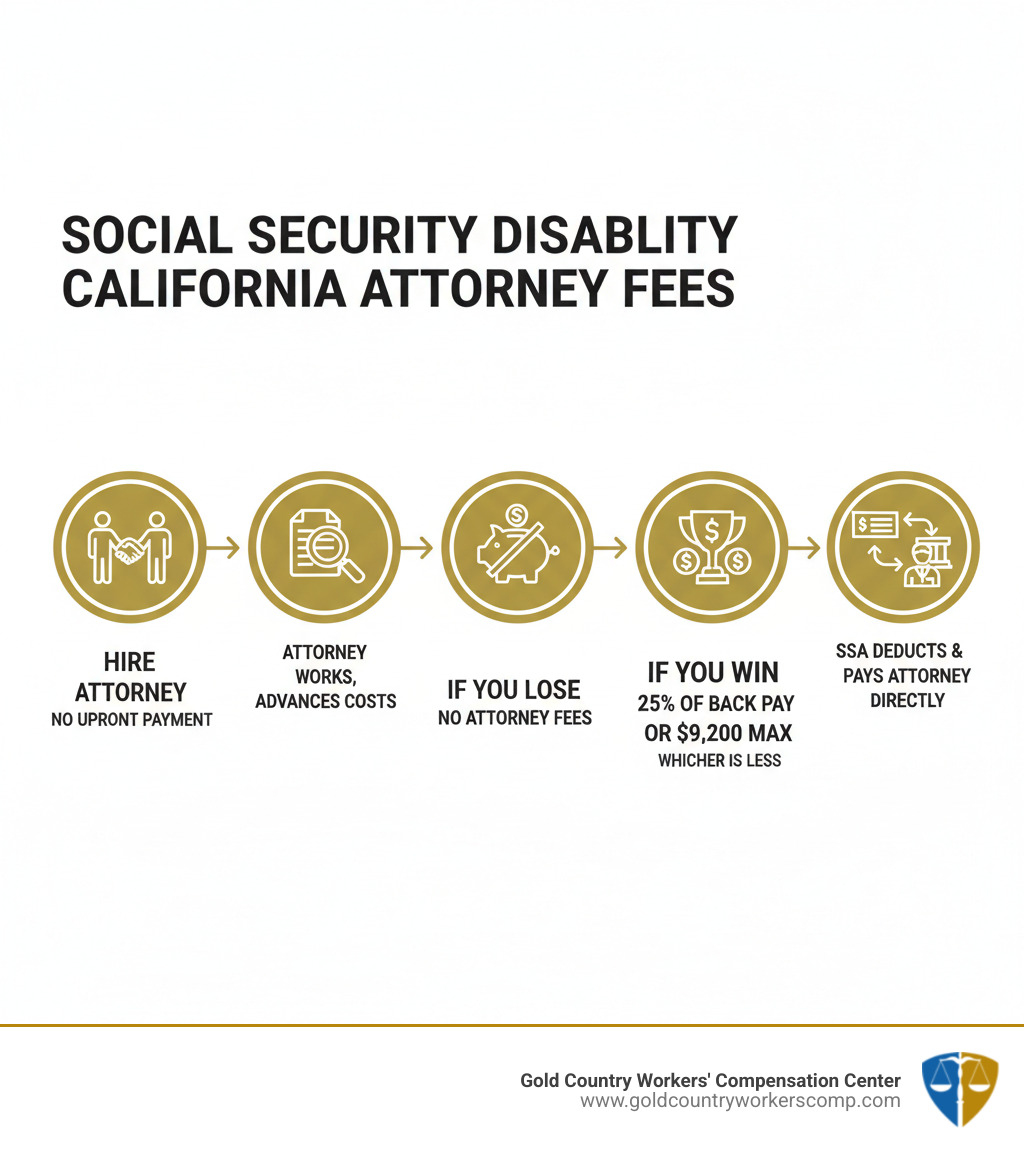
Infographic showing the no-win, no-fee structure: Step 1 - Hire attorney with no upfront payment; Step 2 - Attorney works on your case and advances costs; Step 3 - If you lose, you pay no attorney fees; Step 4 - If you win, attorney receives 25% of back pay or $9,200 maximum, whichever is less; Step 5 - SSA automatically deducts fee and pays attorney directly - social security disability california attorney fees infographic

Social security disability california attorney fees terms explained:

The Contingency Fee Model: What “No Fee Unless You Win” Really Means

When you can’t work due to a disability, you shouldn’t have to worry about legal bills. The contingency fee model is a client-friendly arrangement that solves this problem. The simple truth is: we only get paid if you win your case. No win, no fee.

This is how social security disability california attorney fees work. There is no upfront payment and no hourly rates. We invest our time and expertise into your claim, taking on the financial risk ourselves. This setup makes quality legal representation accessible to everyone, regardless of financial situation. If you’re applying for disability benefits, money is likely tight, and the contingency model levels the playing field.

For a more detailed legal definition, you can read about what a contingency fee is in plain terms.

How a Contingency Fee Agreement Works

When you hire us, you’ll sign a written fee agreement that clearly outlines the payment structure. We submit this agreement to the Social Security Administration for approval using SSA Form 1696 (Appointment of Representative). This oversight protects you by ensuring the fees comply with federal regulations.

If your claim is approved and you receive past-due benefits (back pay), the attorney fee is automatically deducted from that amount. We will never take a penny from your future monthly benefits. The SSA handles the fee deduction process automatically, sending us our fee directly and you the rest of your award.

What Happens to Attorney Fees if a Claim is Denied?

If your Social Security disability claim is ultimately denied, you won’t owe us any attorney fees. We absorb the cost of our time and effort. This policy protects you from ending up in debt over an unsuccessful claim.

However, it’s important to clarify that while you won’t owe attorney fees, you might still be responsible for case costs. These are out-of-pocket expenses for things like obtaining medical records. We will discuss these potential costs with you from the beginning and outline them in your fee agreement, so there are no surprises.

The “no win, no fee” promise means you can pursue your claim with experienced legal help without the risk of debt, providing the peace of mind you deserve.

Calculating the Cost: The 25% Rule and the SSA Fee Cap

Calculator next to a calendar highlighting past months, symbolizing back pay calculation - social security disability california attorney fees

When it comes to social security disability california attorney fees, a straightforward formula applies to every SSDI and SSI case. The calculation is based on your “back pay” and is governed by a percentage and a dollar cap.

What is ‘Back Pay’ and How Does it Relate to Fees?

Back pay, or past-due benefits, is the money you’re owed for the period between your disability onset date and your claim’s approval. The SSA determines your Established Onset Date (EOD), and your back pay covers the gap from that date (or your application date) until you are approved. This can result in a substantial lump-sum payment.

For SSDI, back pay can go back 12 months before your application date. For SSI, it typically starts the month after you apply. This accumulated amount is the only money from which an attorney’s fee is taken; your future monthly benefits are entirely yours.

Calculating Social Security Disability California Attorney Fees from Back Pay

By federal law, a disability attorney’s fee is calculated using the 25% rule. The fee is 25% of your past-due benefits, but it cannot exceed a maximum fee cap set by the SSA. This protects you from excessive charges.

Your attorney’s fee is whichever amount is less: 25% of your back pay or the current SSA fee cap. As of November 30, 2024, the cap is $9,200. The SSA adjusts this cap periodically, and you can find the current limit on the SSA’s maximum fee information page.

  • Example 1: If your back pay is $10,000, the fee is 25% ($2,500), since that is less than the $9,200 cap.
  • Example 2: If your back pay is $50,000, 25% would be $12,500. However, the fee is capped at $9,200, so that is the maximum the attorney receives.

This system is transparent and federally regulated, ensuring every disability attorney in California operates under the same rules. These limits protect you, and the fee only applies if you win and receive back pay.

Understanding the Full Picture of Social Security Disability California Attorney Fees

Itemized receipt showing various legal costs - social security disability california attorney fees

Beyond the 25% contingency fee, it’s important to understand the difference between attorney fees and case costs. Attorney fees are for our time and expertise, while case costs are the out-of-pocket expenses paid to third parties to build your case.

Are There Additional Costs Beyond the Lawyer’s Fee?

Yes, but they are typically small. These are expenses for gathering the evidence needed to prove your claim. Common costs include:

  • Medical records fees: Hospitals and clinics charge for copying essential medical records.
  • Doctor’s reports: Your physician may charge a fee to complete a detailed report or a residual functional capacity (RFC) form, which provides critical evidence of your work limitations.
  • Miscellaneous costs: These can include postage, copying, and rare filing fees if a case goes to federal court.

These out-of-pocket expenses typically range from $100 to $200 total for most cases. If a case is more complex, costs might be higher, but we will always discuss this with you beforehand. All costs are itemized in your fee agreement for full transparency.

How Are Out-of-Pocket Expenses Handled?

We advance these costs on your behalf, so you don’t pay anything upfront. If your case is successful, we are reimbursed for these advanced costs from your past-due benefits before the attorney’s fee is calculated.

It is important to note that if your case is unsuccessful, you may still be responsible for reimbursing us for these out-of-pocket expenses. This is different from the “no fee unless you win” promise for attorney fees, as it only covers money we spent on third parties for your case. We will review your fee agreement with you to ensure you understand how these costs work.

The SSA’s Role: How Fees Are Regulated and Paid

Seal of the Social Security Administration - social security disability california attorney fees

Unlike most legal services, the government controls what disability attorneys can charge. The Social Security Administration (SSA) regulates, approves, and directly pays attorney’s fees to protect claimants and ensure that social security disability california attorney fees are fair.

How the SSA Regulates Social Security Disability California Attorney Fees

The SSA uses two methods to authorize attorney fees:

  1. Fee Agreement Process: This is the most common method. Your attorney submits your signed fee agreement (specifying the 25%/$9,200 cap) to the SSA for approval. If it meets federal requirements, the SSA approves it.
  2. Fee Petition Process: For unusually complex cases that require extensive work or multiple appeals, an attorney can file a detailed fee petition. The SSA reviews the petition to determine a reasonable fee based on the work performed.

You can read the detailed SSA regulations on fee payment for more specifics on these rules.

When and How Are Fees Paid?

Once your claim is approved, the SSA handles the payment automatically. They withhold the approved attorney fee from your back pay and send it directly to your attorney. You receive the remainder of your back pay along with a Notice of Award that details the total amount, your ongoing monthly benefit, and the fee deduction. In the rare event the SSA mistakenly sends you the full amount, you are still obligated to pay your attorney.

What if a Case Requires Appeals?

If your case requires appeals to the Appeals Council or federal court, the basic fee structure (25%/$9,200 cap) still applies. However, for this extensive and complex work, your attorney may file a fee petition to request a fee beyond the standard cap. This is not guaranteed; the attorney must justify the request, and the SSA must approve it. Some attorneys use two-tier fee agreements to account for this possibility at higher appeal levels. Even in federal court, fees are generally capped at 25% of past-due benefits.

Is Hiring a California Disability Lawyer Worth the Cost?

The value a skilled attorney brings to your disability claim typically far exceeds the cost. The choice is often between 75% of a successful claim or 100% of a denied one. For most, the answer is clear.

Statistics show that claimants with representation are more likely to be approved for benefits. The Social Security disability system is complex, with strict rules and overwhelming paperwork. A missed deadline or incomplete form can derail a valid claim.

An experienced disability attorney knows what the SSA requires. We help you:

  • Develop proper evidence: We gather the right medical records and reports that align with SSA regulations.
  • Avoid common mistakes: We prevent errors in documentation that often lead to denials.
  • Maximize your benefits: At hearings, we prepare you for questions, present your case effectively, and cross-examine experts to strengthen your claim.

This expert guidance significantly increases your chances of a successful outcome.

Factors to Consider When Choosing a Lawyer

When evaluating attorneys for your social security disability california attorney fees and claim, look for these key factors:

  • Experience with the SSA: You need a specialist with a proven track record. Gold Country Workers’ Comp offers nearly 50 years of combined experience in disability law.
  • Local knowledge: An attorney familiar with judges in your area—like Roseville, Nevada City, and greater Sacramento—can tailor your hearing strategy.
  • Free case evaluations: Reputable attorneys offer free consultations to discuss your case without obligation. We believe you should have all the information before making a decision.
  • Communication style: Choose someone who communicates clearly and promptly.
  • Client reviews: Positive feedback reflects the experience you can expect. As one client said, “I received SSDI in 2 months on contingency—2 years faster than the typical nightmares I was hearing about.”

Hiring a California disability lawyer is worth the cost. The increased chance of success and peace of mind often result in a much better outcome than going it alone.

Frequently Asked Questions about California Disability Attorney Fees

Here are answers to common questions about social security disability california attorney fees.

Can a disability lawyer charge more than the standard fee cap?

In most cases, no. The federally mandated $9,200 cap is the maximum. However, for exceptionally complex cases involving multiple appeals or federal court action, an attorney can file a fee petition with the SSA. This is a request for a higher fee based on extraordinary work. The SSA must review and approve any fee petition, ensuring it is reasonable. This is rare and not something an attorney can decide alone.

Do all disability lawyers in California offer free consultations?

Most reputable disability attorneys do. We certainly offer a free, no-obligation case evaluation at Gold Country Workers’ Comp. This allows you to understand your claim’s strengths, our fee structure, and your options without any financial commitment. Always confirm that a consultation is free before meeting with a lawyer.

Does an experienced lawyer cost more than a new one?

No. The regulated fee structure—25% of back pay or the $9,200 cap—applies to every representative, regardless of experience. This means you can hire an attorney with decades of experience for the same price as a novice. At Gold Country Workers’ Comp, our nearly 50 years of combined experience comes at no premium. You get the benefit of our expertise for the same regulated fee, making it a clear advantage to choose an experienced firm.

Get the Right Guidance for Your Disability Claim

Friendly lawyer shaking hands with a relieved client - social security disability california attorney fees

Understanding social security disability california attorney fees reveals a system designed to help you. With no upfront costs and a fee that is contingent on winning, you can access legal help without financial risk. The fees are regulated by the federal government, capped at 25% of back pay or $9,200 (whichever is less), and paid directly by the SSA.

Statistics show that legal representation significantly increases your chances of winning. At Gold Country Workers’ Comp, our nearly 50 years of experience helps people in Roseville, Nevada City, and the Sacramento area steer this complex process. We know how to build a strong case, avoid common mistakes, and effectively represent you at hearings.

Your disability claim is too important to leave to chance. These benefits are crucial for your financial stability and well-being. Hiring an experienced attorney often results in a better outcome, even after the fee is paid.

We offer free case evaluations to provide honest answers and clear guidance. With our no-win, no-fee promise, you have nothing to lose. Contact us for a free case evaluation and let’s discuss how we can help you get the benefits you deserve.

Your Local Legal Lifeline: Finding Social Security Lawyers Near You

social security lawyers near me

Why Finding the Right Social Security Lawyer Matters When You Can’t Work

When a health crisis stops you from working, searching for social security lawyers near me is a critical step toward financial stability. The Social Security disability system is complex, and securing the benefits you need is a significant challenge.

Quick Answer: How to Find Social Security Lawyers Near You

Three Fastest Ways to Connect with Local Disability Attorneys:

  1. Visit usa.gov/legal-aid or call 1-844-872-4681 for affordable legal help.
  2. Contact your state bar association for lawyer referral services specializing in Social Security disability.
  3. Use legal matching services that connect you with pre-screened attorneys in your area at no cost.

What to Expect: Most Social Security disability lawyers work on contingency—you pay nothing unless you win, with fees capped at 25% of back pay or $7,200, whichever is less.

The reality is that most people are denied disability benefits on their first try. However, your chances of approval increase significantly with an experienced Social Security disability attorney.

The system involves complicated forms, strict medical criteria, tight deadlines, and a multi-stage appeals process. A single mistake can lead to months of delays or an outright denial. This is where local legal help becomes essential. An attorney who knows Social Security law can guide you through the maze, help you gather the right medical evidence, and represent you at hearings. They understand local SSA office procedures and can make the difference between denial and approval.

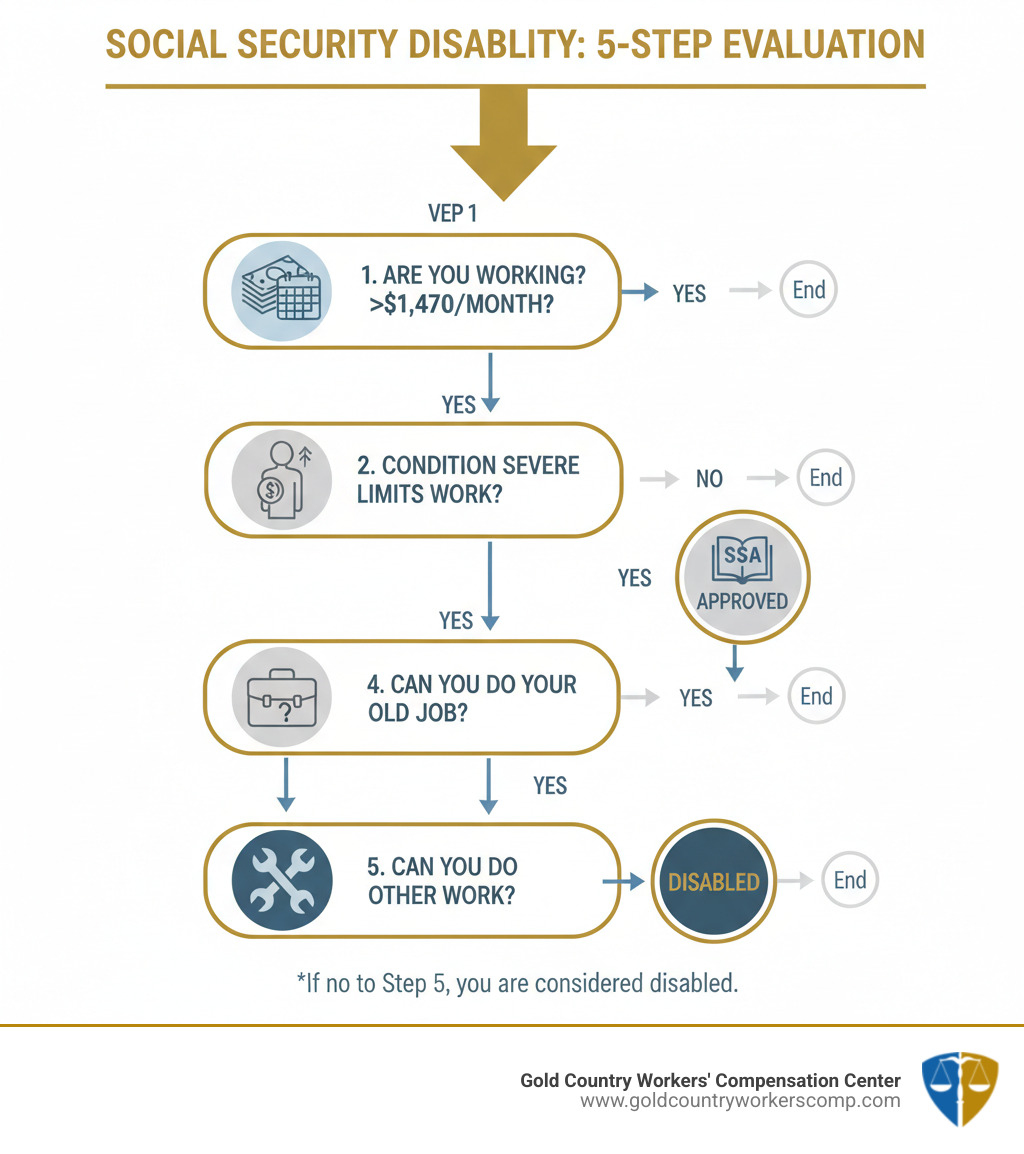
Infographic showing the 5-step Social Security Disability evaluation process: Step 1 - Are you working and earning more than $1,470/month? Step 2 - Is your condition severe enough to limit basic work activities? Step 3 - Does your condition meet or equal a listing in the SSA's Blue Book? Step 4 - Can you do the work you did before? Step 5 - Can you do any other type of work? If you cannot do other work, you are considered disabled. - social security lawyers near me infographic

Quick look at social security lawyers near me:

Understanding Social Security Disability and When to Seek Help

There are two different Social Security disability programs, and understanding them is key if you can no longer work. If you’re searching for social security lawyers near me, you’re likely wondering which program applies to you and when to get legal help.

What are SSDI and SSI?

Social Security Disability Insurance (SSDI) is an insurance program you pay into through Social Security taxes from your paychecks. It’s for people who have worked long enough to earn sufficient “work credits.” Your benefit amount is based on your lifetime earnings. After two years on SSDI, you become eligible for Medicare.

Supplemental Security Income (SSI) is a needs-based program for disabled, blind, or elderly individuals with very limited income and resources. It is not based on your work history and is funded by general tax revenues. Benefit amounts are standardized, and you typically qualify for Medicaid immediately upon approval.

The SSA uses the same strict medical definition of “disability” for both programs: you must be unable to perform any substantial gainful activity due to a medical impairment expected to last at least 12 months or result in death. This strict standard is why most initial claims are denied.

Feature Social Security Disability Insurance (SSDI) Supplemental Security Income (SSI)
Eligibility Based on work history and paying Social Security taxes Based on financial need (limited income and resources)
Funding Source Social Security taxes (payroll deductions) General tax revenues
Health Benefits Medicare (after a waiting period) Medicaid
Benefit Amount Varies based on lifetime earnings Standardized, based on federal and state maximums, and other income
Work Credits Required Not required

Some people may qualify for both programs simultaneously, depending on their work history and financial situation.

When Should You Hire a Disability Lawyer?

Your chances of approval increase significantly with an experienced attorney. The Social Security system is confusing, with forms that can be used to deny your claim. So when should you call social security lawyers near me?

  • Before you apply: This is the ideal time. A lawyer can help you gather the right medical evidence and complete tricky forms like the Adult Function Report correctly from the start, avoiding common mistakes that sink claims.
  • After a denial letter: Most people seek help at this stage. You only have 60 days to appeal, so acting fast is crucial. A denial doesn’t mean your case is hopeless; it means you need an expert to steer the appeals process.
  • If you’re over 50: Special “grid rules” apply that consider your age, education, and work history. An attorney can use these rules to your advantage.
  • If you have complex medical conditions: Conditions like fibromyalgia, chronic fatigue, or mental health issues can be difficult to prove. A lawyer knows how to document these conditions in a way the SSA understands.

The bottom line is that the SSA has complicated requirements. The system often seems designed to deny claims, especially at the initial stage. You don’t have to steer this maze alone.

The Tangible Benefits of Hiring a Social Security Lawyer

When you’re dealing with a serious health condition, navigating the Social Security disability system alone adds unnecessary stress. An experienced social security lawyers near me becomes your advocate and guide.

How a Lawyer Maximizes Your Chance of Approval

A lawyer and client reviewing documents together, demonstrating collaboration and detailed case preparation. - social security lawyers near me

Statistics show that legal representation dramatically improves your chances of getting approved. Here’s how we help:

  • Avoiding Critical Errors: The application process is full of traps. The Function Report (SSA-3373-BK) is particularly dangerous, as your answers about daily activities can be used against you. We help you describe your limitations accurately without sabotaging your claim.
  • Gathering Key Medical Evidence: A successful claim depends on strong medical evidence. We work with you and your doctors to collect the records and, crucially, obtain statements from your physicians that address your functional limitations in the specific way the SSA requires.
  • Developing a Custom Strategy: Every case is unique. We identify the strongest arguments for your approval based on your age, education, work history, and medical conditions, whether that involves meeting an SSA Blue Book listing or proving you cannot perform any type of work.
  • Managing Deadlines and Hearings: The SSA has strict deadlines for appeals and submitting evidence. We handle all communications and deadlines, ensuring nothing falls through the cracks. If your case goes to a hearing, we prepare you, present your evidence, cross-examine experts, and argue your case before the judge.
  • Reducing Your Stress: Handing the legal complexities over to us allows you to focus on your health. We become your buffer against the bureaucracy in a system that often feels designed to say “no.”

How Do Social Security Disability Lawyers Get Paid?

Hiring a disability lawyer won’t cost you anything out of pocket. We work on a contingency fee basis, which means we only get paid if you win.

  • No upfront costs or retainer fees.
  • Our fee comes from your back pay. When your claim is approved, you receive “back pay” for the months you were owed benefits. Our fee is taken directly from this amount.
  • The fee is federally capped. The fee is 25% of your back pay or $7,200, whichever is less. This ensures you keep the majority of your benefits.

The SSA handles the payment directly, so you never have to worry about it. This “no win, no fee” structure means there is no financial risk in getting our help. We are as invested in winning your case as you are.

How to Find the Best Social Security Lawyers Near Me

When you search for social security lawyers near me in areas like Roseville or Nevada City, California, you’re looking for a partner to fight for your future. Finding the right one is crucial.

What to Look for When Choosing Social Security Lawyers Near Me

You need an attorney who knows the law and understands your situation. Here’s what matters:

  • Specialized Experience: Social Security disability law is a niche field. You need an attorney who focuses on these cases, not a general practitioner. Our firm brings nearly 50 years of combined experience in disability and workers’ compensation law.
  • Proven Track Record: A history of winning cases and positive client testimonials speaks volumes. Ask about their approval rates.
  • Professional Reputation: Check for memberships in organizations like the National Organization of Social Security Claimants’ Representatives (NOSSCR.ORG). You can also check their BBB rating and read online reviews.
  • Clear Communication: Your case could take months or years. You need a lawyer who returns calls and keeps you informed. We believe in early intervention and clear communication.
  • Local Expertise: A local lawyer knows the regional SSA offices and administrative law judges. Our firm is based in Grass Valley, serving clients throughout the Sacramento area, including Roseville and Nevada City.

Preparing for Your Initial Consultation

Being prepared for your first meeting helps your attorney understand your case. Bring the following:

  • Medical Records: Doctor’s notes, test results, hospital discharge papers, and a list of all providers with their contact information.
  • Medication List: A complete list of all prescriptions and over-the-counter medications you take.
  • Work History: A list of your jobs for the last 15 years, with titles, dates, and a description of your duties.
  • SSA Correspondence: Any denial letters or other notices you have received from the Social Security Administration.
  • Notes on Daily Life: Be ready to discuss how your condition affects daily activities like cooking, cleaning, and socializing.

Where Can I Find Social Security Lawyers Near Me?

Finding a qualified attorney in California is straightforward if you know where to look.

  • The federal government offers resources at usa.gov/legal-aid or by calling 1-844-872-4681.
  • State bar associations, like the State Bar of California, provide lawyer referral services for vetted specialists.
  • Legal aid societies offer free or low-cost services to those who meet income requirements.

When searching for social security lawyers near me in Roseville and Nevada City, we invite you to contact Gold Country Workers’ Compensation Center. There is no consultation fee, and our team is ready to help you work toward a positive outcome.

Your Lawyer’s Role: Navigating the Application and Appeals Labyrinth

The path to securing Social Security disability benefits is a maze of rules and deadlines. A dedicated social security lawyers near me can guide you through every stage, from the initial application to any necessary appeals.

A flowchart illustrating the Social Security Administration's application and appeals process, starting from Initial Application, moving to Reconsideration, then Administrative Law Judge Hearing, followed by Appeals Council, and finally Federal Court. - social security lawyers near me

Assistance with the Initial Application

While you can apply for disability benefits online yourself, it’s often not advisable. We help build a winning case from day one by ensuring your application is complete, accurate, and presents your case favorably.

A critical part of the application is the SSA’s Adult Function Report form (SSA-3373-BK). This document asks about your daily activities, and the SSA often uses your answers to deny claims. For example, mentioning you can prepare simple meals might be interpreted as an ability to work. We guide you in answering these questions truthfully without inadvertently harming your case. This early intervention is a cornerstone of our practice.

Fighting a Denial: The Appeals Process Explained

Most initial claims are denied. This is not the end, but it is when legal representation becomes crucial. You have only 60 days (plus 5 for mailing) from the date on your denial letter to file an appeal. We ensure this deadline is never missed.

The appeals process has several stages:

  1. Reconsideration: A different SSA examiner reviews your file. We submit new evidence and address the reasons for the initial denial.
  2. Administrative Law Judge (ALJ) Hearing: If denied again, we request a hearing. This is your best chance to win. We prepare you for the hearing, present your case, cross-examine any vocational or medical experts, and submit a detailed legal brief arguing why you qualify for benefits.
  3. Appeals Council: If the ALJ denies your claim, we can ask the Appeals Council to review the decision for legal errors.
  4. Federal Court: As a final step, we can file a lawsuit in Federal Court, a complex process requiring significant legal expertise.

Throughout this labyrinth, we manage the process so you can focus on your health. We are committed to fighting for the benefits you deserve, no matter how many stages it takes.

Frequently Asked Questions about Social Security Lawyers

When considering hiring a lawyer for your disability claim, it’s natural to have questions about cost, necessity, and next steps. Here are answers to the questions we hear most from people searching for social security lawyers near me.

How much does a Social Security disability lawyer cost?

You pay nothing upfront. Social Security disability lawyers work on a contingency fee basis. This means we only get paid if you win your case.

Our fee is taken directly from the “back pay” you receive upon approval. The fee is federally regulated and capped at 25% of your back pay or $7,200, whichever is less. The Social Security Administration handles the payment, so you never have to worry about billing. This system ensures everyone can afford quality legal help.

Can I apply for disability benefits on my own?

Yes, you can apply for disability benefits online by yourself. However, statistics show that your chances of approval are significantly higher with legal representation. The SSA has very specific rules about medical evidence and what qualifies as a disability. Most initial applications are denied, often due to simple errors or incomplete information. An attorney helps you avoid these pitfalls and steer the complex process while you focus on your health.

My claim was denied. Is it too late to hire an attorney?

No, it’s the perfect time. In fact, receiving a denial is the most common reason people seek our help. A denial is not the end; it’s the start of the appeals process, where an experienced attorney is critical.

You must act quickly. You only have 60 days (plus 5 for mailing) from the date on your denial letter to file an appeal. If you miss this deadline, you have to start the entire application over.

When you bring us a denial letter, we identify why you were denied and build a stronger case for your appeal. We manage the entire appeals process—from Reconsideration to a hearing before a judge—ensuring all deadlines are met and your case is presented effectively. If you’ve been denied, don’t lose hope. Call us immediately.

Conclusion: Your Next Step Towards Securing Your Benefits

A person looking relieved and hopeful, with a sunrise in the background, symbolizing a new beginning. - social security lawyers near me

When your health prevents you from working, the financial pressure can be overwhelming. You don’t have to face the complex Social Security disability system alone.

Finding the right social security lawyers near me can dramatically improve your chances of success. An experienced attorney helps you avoid critical errors, gathers the necessary medical evidence, and stands by you at hearings. This support is available with no financial risk, as we work on a contingency basis—we only get paid if we win your case, with fees capped by federal law.

For nearly 50 years, Gold Country Workers’ Compensation Center has been protecting workers’ rights in California. From our office in Grass Valley, Kim LaValley and Kyle Adamson have helped countless clients in Roseville, Nevada City, and the surrounding region secure the benefits they need. Our commitment is to early intervention and dedicated advocacy.

Whether you are just considering applying or have already received a denial letter, now is the time to act. The 60-day appeal deadline is strict.

Your next step is simple: Get a free evaluation of your Social Security Disability case. There is no consultation fee or obligation—just honest guidance from a team that wants to help you achieve a positive outcome. Let us take it from here.

Unlock Your Benefits: Practical Social Security Disability Advice

Social Security disability advice

Why Understanding Social Security Disability Benefits Matters

Social Security disability advice can be overwhelming when a medical condition prevents you from working. Understanding your options quickly is crucial.

Quick Answer: Essential Steps for Social Security Disability Benefits

  1. Determine your eligibility – You need either enough work history (SSDI) or limited income/resources (SSI).
  2. Understand the disability definition – Your condition must prevent substantial work for at least one year or be terminal.
  3. Gather your documentation – Collect medical records, work history, and personal information.
  4. Apply through SSA – Apply online, by phone, or in person (expect a 6-8 month initial review).
  5. Be prepared for denial – Most initial applications are denied; appeals are common and often successful.
  6. Consider professional help – A disability attorney can improve your chances in a complex process.

The reality is stark: a 20-year-old worker has a 1-in-4 chance of developing a disability before reaching full retirement age, yet the process to get benefits is complicated.

The Social Security Administration (SSA) runs two main programs: Social Security Disability Insurance (SSDI) for workers who’ve paid into the system, and Supplemental Security Income (SSI) for people with limited income and resources, regardless of work history.

Both programs use the same strict definition of disability: you must be unable to do substantial work due to a medical condition that will last at least one year or is expected to result in death. Partial or short-term disabilities do not qualify.

The application process averages 6 to 8 months, and many initial claims are denied. Understanding how the SSA evaluates claims and what evidence they need is key to success.

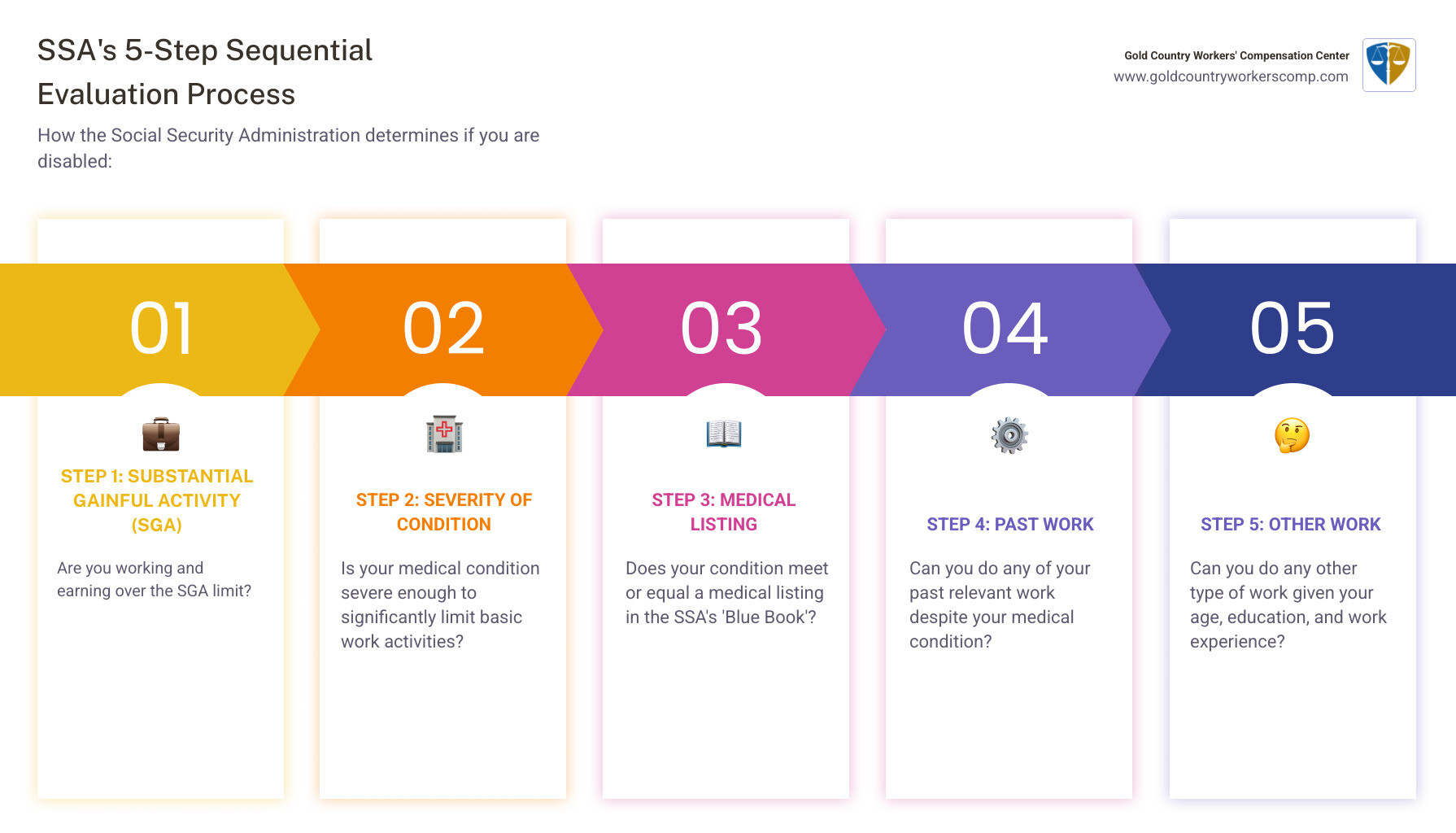
infographic showing the SSA's 5-step sequential evaluation process: Step 1 - Are you working and earning over the SGA limit? Step 2 - Is your medical condition severe? Step 3 - Does your condition meet or equal a medical listing? Step 4 - Can you do your past work? Step 5 - Can you do any other work given your age, education, and skills? - Social Security disability advice infographic pillar-5-steps

Social Security disability advice terms made easy:

Understanding Your Eligibility: SSDI vs. SSI

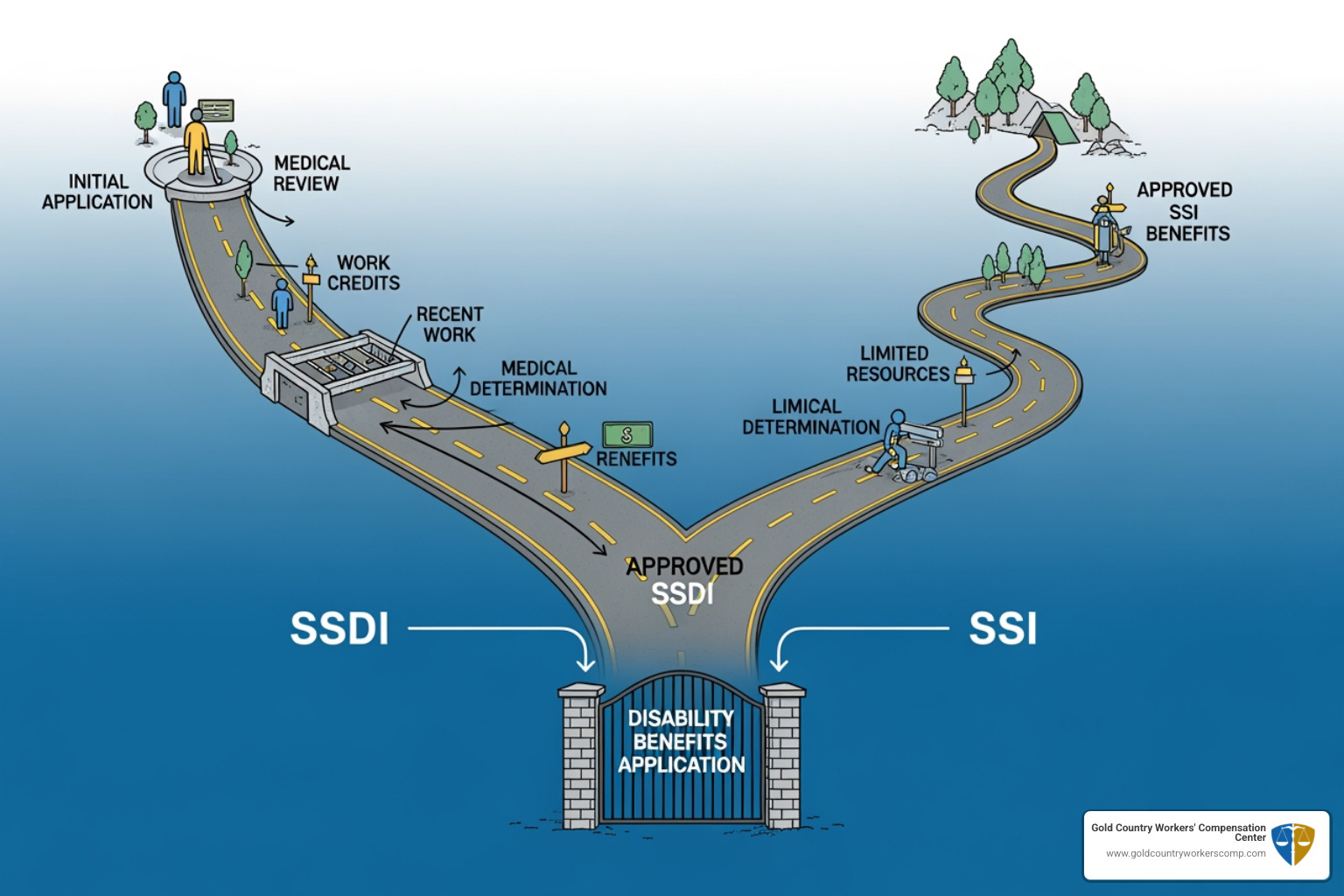
Figuring out which Social Security disability program you might qualify for is a critical first step. The Social Security Administration (SSA) runs two distinct programs for people with disabilities: Social Security Disability Insurance (SSDI) for those who have worked and paid into the system, and Supplemental Security Income (SSI) for those with limited financial means.

flowchart showing paths to SSDI and SSI - Social Security disability advice

Both programs use the same strict definition of disability. Your medical condition must prevent you from performing Substantial Gainful Activity (SGA)—earning above a certain monthly amount. However, the non-medical qualifications for each program are very different. In California, SSI recipients may also receive a state supplement, which adds to the federal benefit amount.

What are SSDI and SSI?

Understanding the difference between these programs is essential Social Security disability advice.

Social Security Disability Insurance (SSDI) is an insurance program funded by Social Security taxes from your paychecks. To qualify, you must have earned enough work credits by working and paying taxes long enough and recently enough. If approved, your benefit amount is based on your average lifetime earnings, and you become eligible for Medicare after a two-year waiting period.

Supplemental Security Income (SSI) is a needs-based program funded by general tax revenues. It does not require a work history. Eligibility is determined by your income and resources, which must be below strict federal limits. SSI provides a fixed monthly benefit, which California supplements. SSI recipients in California are typically eligible for Medicaid (Medi-Cal) immediately.

It’s possible to qualify for both programs simultaneously, which is known as receiving concurrent benefits. This occurs if you are eligible for SSDI but your monthly benefit is low enough to also meet SSI’s financial criteria.

Feature Social Security Disability Insurance (SSDI) Supplemental Security Income (SSI)
Eligibility Based on work history and payment of Social Security taxes (work credits). Based on financial need (limited income and resources); no work history required.
Funding Source Social Security taxes (payroll deductions). General tax revenues.
Benefit Amt. Varies based on average lifetime earnings. Fixed federal benefit rate, potentially supplemented by state funds (like in California), reduced by countable income.
Health Benefits Medicare coverage automatically after 2 years of disability benefit receipt. Medicaid (Medi-Cal in California) eligibility usually begins immediately upon SSI approval.
Dependents Certain family members (spouse, children) may be eligible for benefits on your work record. Generally, no additional benefits for dependents, though a child can receive SSI if disabled and meets financial criteria.
Taxable? May be taxable depending on your total income. Generally not taxable.

How the SSA Determines You Are Disabled

The SSA’s definition of disability is purely legal and can differ from your doctor’s opinion. You are considered disabled only if a medical condition prevents you from doing substantial work for at least one year or is expected to be terminal. Partial or short-term disability does not qualify.

While your doctor’s opinion is important medical evidence, the SSA uses a rigid 5-step evaluation process to make its decision:

  1. Are you working? If you are earning above the SGA limit, you generally won’t be considered disabled.
  2. Is your condition severe? Your condition must significantly limit basic work activities.
  3. Does your condition meet a listing? The SSA compares your condition to its Listing of Impairments (the “Blue Book”).
  4. Can you do your past work? If your condition doesn’t meet a listing, the SSA assesses if you can perform any of your past jobs.
  5. Can you do any other work? If you can’t do your past work, the SSA considers your age, education, work experience, and Residual Functional Capacity (RFC)—what you can still do despite your limitations—to determine if you can perform other work.

To get a preliminary idea of your eligibility, you can use the Social Security benefits questionnaire on the SSA’s website.

The Application Process: A Step-by-Step Guide

Applying for Social Security disability benefits is a lengthy process, with initial decisions often taking 6 to 8 months. While the wait can be difficult, proper preparation can make the journey less overwhelming.

checklist and organized documents - Social Security disability advice

Think of the application as building a case to prove your medical condition prevents you from working and will last at least a year or is terminal. You can apply online, by phone, or in person at a local Social Security office, including those serving the Roseville and Nevada City areas. Once submitted, your application is sent to your state’s Disability Determination Services (DDS) for a medical review.

Gathering Your Documents: Essential Social Security Disability Advice

Complete documentation is critical to your claim’s success. The SSA’s Adult Disability Starter Kit can help you organize the necessary information:

  • Personal Information: Birth certificate, Social Security number, and proof of citizenship or legal status.
  • Medical Records: A complete list of all doctors, hospitals, and clinics, including contact information and dates of treatment. Incomplete medical information is a primary cause of delays and denials.
  • Medication List: All prescribed medications, including dosages and prescribing doctors.
  • Work History: A 15-year work history with job titles, dates, and specific physical and mental duties for each position.
  • Education and Training: Your highest level of schooling, vocational training, and any special skills.
  • Financial Information (for SSI): Details about your income, bank accounts, and other resources to prove you meet the strict financial limits.

Common Reasons for Claim Denials

Most initial applications are denied, but often for fixable reasons. Understanding these common pitfalls can help you prepare a stronger claim.

  • Insufficient Medical Evidence: The SSA needs objective medical proof of your diagnosis, symptoms, and functional limitations. A simple doctor’s note is not enough.
  • Earning Above the SGA Limit: If your monthly earnings exceed the Substantial Gainful Activity (SGA) limit ($1,550 in 2024 for non-blind individuals), your claim will be denied.
  • Failure to Follow Prescribed Treatment: The SSA may deny your claim if you don’t follow your doctor’s treatment plan without a valid reason, such as cost or significant risk.
  • Lack of Cooperation: Failing to respond to SSA requests or attend scheduled exams can lead to a denial.
  • Application Errors: Incomplete or inconsistent information on the complex application forms can cause delays or denials.
  • Disability is Not Long-Term: Your condition must be expected to last at least 12 months or be terminal.

Receiving a denial letter is disheartening, but it’s not the end of the road. The most crucial piece of Social Security disability advice is: don’t give up. Most initial applications are denied, and the appeals process is where many claimants eventually win their benefits.

calendar with appeal deadline circled - Social Security disability advice

You have a strict 60-day deadline from the date you receive the denial to file an appeal. Missing this deadline could force you to start the entire application process over.

The Four Levels of the Appeals Process

The SSA provides a four-level appeals process, giving you multiple chances to strengthen your case with new evidence.

  1. Reconsideration: A new examiner reviews your file and any new medical evidence. In California, this is a paper review, and denials are still common at this stage.
  2. Administrative Law Judge (ALJ) Hearing: This is a critical stage where you appear before a judge. You can present new evidence, bring witnesses, and explain how your disability affects you. Your chances of approval often increase significantly at this level.
  3. Appeals Council Review: If the ALJ denies your claim, you can ask the Appeals Council to review the decision for legal errors. The Council can uphold the decision, reverse it, or send the case back to the ALJ.
  4. Federal Court Review: The final step is filing a civil lawsuit in U.S. District Court. This is a legally complex process that typically requires an attorney.

You can learn how you can appeal on the SSA’s official website.

How to Prepare for Your Disability Hearing

The ALJ hearing is often the best opportunity to win your case. Thorough preparation is key.

  • Continue Medical Treatment: Keep seeing your doctors and gathering new medical records. The judge needs to see current, ongoing evidence of your condition.
  • Get Detailed Doctor Statements: Ask your physicians for specific statements about your functional limitations (e.g., how long you can stand, how much you can lift).
  • Prepare Witness Testimony: Your spouse, friends, or family can testify about your daily struggles and how your condition has impacted your life.
  • Understand the Questions: Be prepared to answer questions from the judge about your condition, symptoms, daily activities, and work history.
  • Work with a Disability Attorney: This is perhaps the most valuable Social Security disability advice. An experienced attorney knows how to build a strong case, prepare you for the hearing, and present legal arguments to the judge. In our experience serving Roseville and Nevada City, professional representation significantly increases the chances of turning a denial into an approval.

Managing Your Benefits After Approval

Congratulations on your benefit approval! While this is a major relief, your relationship with the SSA continues. You have ongoing responsibilities and opportunities to manage your benefits effectively.

person working at computer part-time - Social Security disability advice

Once approved, you will undergo periodic Continuing Disability Reviews (CDRs) to confirm you are still disabled. The frequency of these reviews (from 18 months to 7 years) depends on whether medical improvement is expected. You must also report any changes in your work status, income, or address to the SSA to avoid overpayments.

Your approval also comes with healthcare coverage. SSDI recipients get Medicare after a 24-month waiting period, while SSI recipients in California typically get Medicaid (Medi-Cal) immediately. You may also consider opening an ABLE account, a tax-advantaged savings account for disability-related expenses.

Working While Receiving Benefits

One of the most empowering pieces of Social Security disability advice is that you can try to return to work. The SSA offers Work Incentives to help you do so without immediately losing your benefits.

  • Trial Work Period (TWP): SSDI recipients get 9 months to earn any amount of money while keeping their full benefits.
  • Extended Period of Eligibility: After the TWP, you have a 36-month period where you receive benefits for any month your earnings fall below the SGA level.
  • Impairment-Related Work Expenses (IRWE): The cost of items you need for work due to your disability can be deducted from your earnings, potentially allowing you to earn more while keeping benefits.
  • Ticket to Work Program: This free, voluntary program offers employment support services to help you find and keep a job.

For complete details, consult the SSA’s Red Book – A Guide to Work Incentives.

Understanding Changes to Your Benefits

Your benefits can change over time. It’s crucial to report any changes in your work, income, living situation, or legal status to the SSA.

Be aware that SSDI benefits may be taxable depending on your total household income, while SSI benefits are generally not. When you reach full retirement age, your SSDI benefits will automatically convert to retirement benefits, usually at the same amount. Understanding these rules is vital for long-term financial planning.

Conclusion

Navigating the Social Security disability system is a complex journey, filled with intricate rules and potential setbacks. It can feel overwhelming, especially while managing a health condition that prevents you from working.

However, with the right Social Security disability advice and a clear understanding of the process, you can significantly improve your chances of success. We’ve covered the differences between SSDI and SSI, the SSA’s definition of disability, the application and appeals process, and how to manage your benefits after approval.

You don’t have to walk this path alone. For nearly 50 years, Gold Country Workers’ Comp has been a trusted hand for folks in California, helping them through the Workers’ Compensation and Disability/Social Security maze. We’re all about stepping in early, offering expert guidance right from the start with no initial consultation fee. Our goal is always to find cost-effective solutions and achieve positive outcomes for people just like you in Grass Valley, Roseville, Nevada City, and beyond. Our team, including Kim LaValley and Kyle Adamson, is passionate about helping you resolve your issues and move forward.

If you’re struggling with a disability and need a helping hand with your SSDI or SSI claim, or if you’ve faced a denial and need help with an appeal, please know we’re here for you. Let us help you open up the benefits you’re entitled to.

Learn more about our Social Security disability services

Choosing Your Champion: A Guide to California Disability Lawyers

California disability attorney

Why You Need a California Disability Attorney

A California disability attorney helps disabled individuals steer the complex process of applying for and appealing Social Security Disability Insurance (SSDI), Supplemental Security Income (SSI), and other disability benefits. Here’s what they do:

What a California Disability Attorney Does:

  • Guides you through applications – Ensures forms are completed accurately with supporting medical evidence.
  • Appeals denied claims – Represents you at hearings before Administrative Law Judges.
  • Works on contingency – You pay nothing unless you win your case (typically 25% of back pay, capped by law).
  • Gathers evidence – Obtains medical records, doctor opinions, and vocational assessments.
  • Increases approval chances – Expert representation significantly improves success rates, especially on appeal.

When you’re unable to work due to a disabling condition, the financial strain is immediate. Unfortunately, most initial disability claims are denied. The Social Security Administration’s rules are strict, and the process is lengthy and confusing. In California, the high cost of living adds to the pressure while you wait months—or years—for a decision. Initial applications take three to six months, and appeals can add another 12 to 18 months.

You don’t have to face this system alone. A skilled California disability attorney knows how to build a strong case from the start, avoiding common mistakes that lead to denials. They understand the medical and vocational evidence needed to prove you are disabled under Social Security’s definition. Whether you’re filing for the first time or appealing a denial, the right legal champion can mean the difference between giving up and getting the benefits you’ve earned.

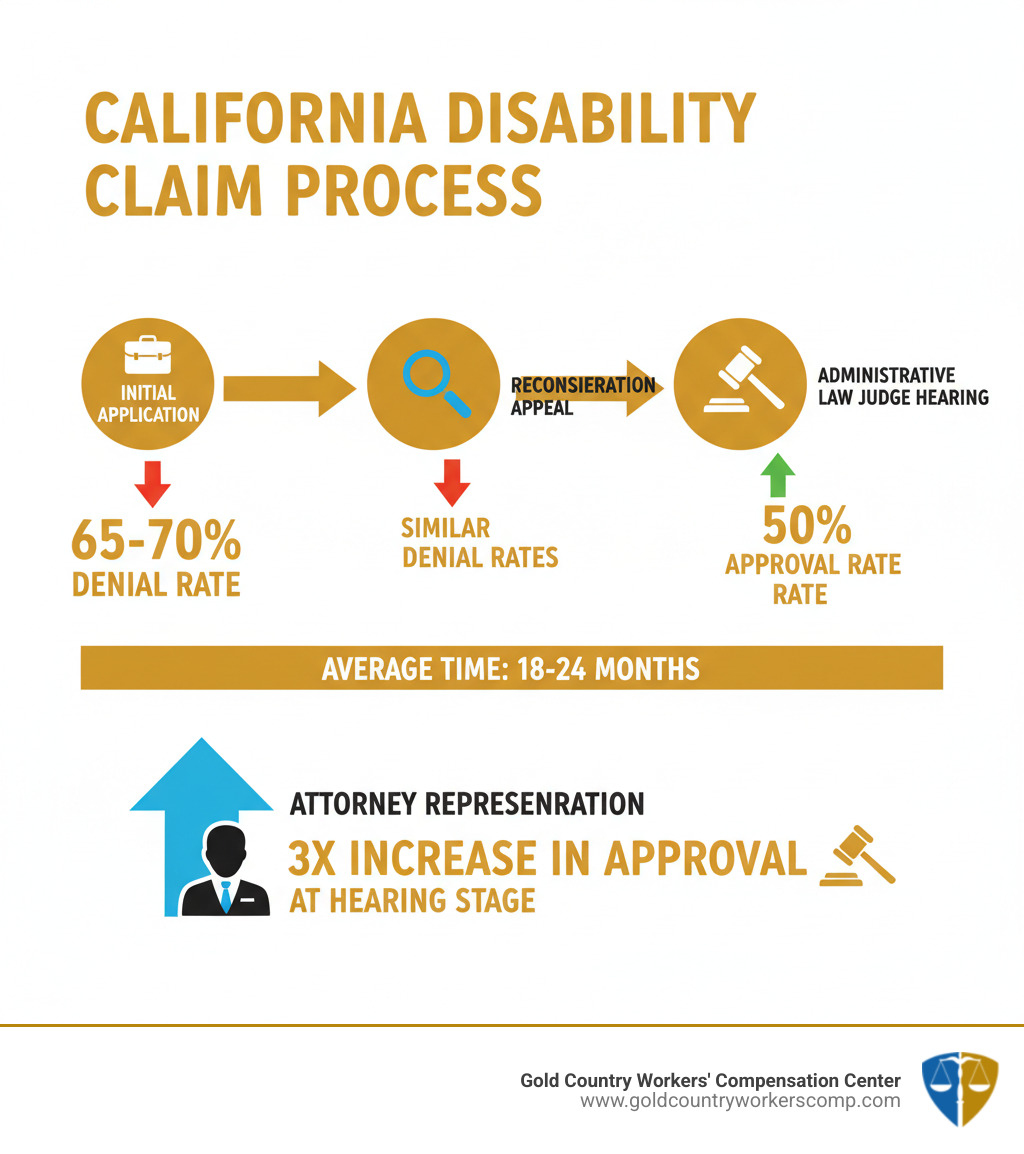
Infographic showing disability claim process in California: Initial applications have a 65-70% denial rate; Appeals to reconsideration have similar denial rates; Administrative Law Judge hearings have 50% approval rates; Average time from initial application to hearing decision is 18-24 months; Attorney representation increases approval chances by 3x at hearing stage - California disability attorney infographic

Similar topics to California disability attorney:

Understanding the Landscape of Disability Benefits in California

When a disability prevents you from working, it’s hard to know which benefits you qualify for. California offers a mix of federal, state, and private programs, each with its own rules and applications. Many people qualify for several programs at once, and a California disability attorney can help you steer this landscape to maximize your financial support.

Flowchart of disability benefits types - California disability attorney

Social Security Disability: SSDI vs. SSI

The Social Security Administration (SSA) runs two separate federal programs: Social Security Disability Insurance (SSDI) and Supplemental Security Income (SSI). Both help people who can’t work due to a disability, but they are designed for different situations.

Feature Social Security Disability Insurance (SSDI) Supplemental Security Income (SSI)
Eligibility Requires a significant work history, having paid FICA taxes. Based on your earnings record. Needs-based program for low-income individuals. Does not require a work history.
Funding Funded by Social Security taxes (FICA contributions). Funded by general tax revenue.
Work Credits Requires a certain number of “work credits” earned by working and paying Social Security taxes over time. No work credits required.
Income/Assets Not based on income or assets (though working above Substantial Gainful Activity (SGA) limits can affect eligibility). Strict income and asset limits (e.g., in 2023, for individuals, generally no more than $1,470/month in revenue, or $2,460/month if blind).
Benefit Amount Varies based on your lifetime average earnings. Federal benefit rate, often supplemented by California state payments.
Medical Coverage Generally leads to Medicare eligibility after a waiting period. Generally leads to Medi-Cal (Medicaid) eligibility.

SSDI is like an insurance policy. The FICA taxes you paid while working earned you “work credits.” If you become disabled, SSDI replaces a portion of your lost income based on your lifetime earnings.

SSI is a safety net for those with limited income and resources, regardless of work history. If you are disabled, blind, or over 65 and meet strict financial limits, SSI provides a basic monthly payment. California adds a state supplement to the federal benefit to help with the high cost of living. Some individuals may qualify for both programs.

State, Public, and Private Disability Programs

Beyond Social Security, California residents may qualify for other benefits.

California State Disability Insurance (SDI) is a short-term program administered by the Employment Development Department (EDD). If you’ve paid into SDI through your paycheck, you can receive partial wage replacement for up to 52 weeks for a non-work-related illness, injury, or pregnancy.

Private Long-Term Disability (LTD) insurance is often an employee benefit. However, most LTD plans are governed by a complex federal law, the Employee Retirement Income Security Act (ERISA). ERISA claims are difficult; denials are reviewed by the same insurance company that denied you, not a jury. An attorney experienced in ERISA is crucial for navigating this process.

Public employee retirement systems like the California Public Employees’ Retirement System (CalPERS) and the California State Teachers’ Retirement System (CalSTRS) offer disability retirement for government workers. Benefits differ based on whether the disability is service-connected or not. The rules are complex, making legal consultation advisable.

The Disability Claim Process: Common Problems and Why Claims Are Denied

Applying for disability benefits is a long, strict, and emotionally draining process. The endless paperwork and bureaucracy are overwhelming, and in California, the financial pressure of waiting for a decision can be immense. The hard truth is that most people are denied the first time they apply. A California disability attorney can help you steer the system and avoid common pitfalls.

Person stressed filling paperwork - California disability attorney

The Four Stages of a Disability Claim

The Social Security disability claim process has four main stages:

  1. Initial Application: You submit your application with medical and work history. The SSA takes three to six months to review it, and most applications are denied at this stage due to insufficient evidence or technical errors.
  2. Reconsideration: If denied, you can ask for a new examiner to review your file. Unfortunately, denial rates at this stage remain very high.
  3. Administrative Law Judge (ALJ) Hearing: This is your best chance to win an appeal, especially with an attorney. You present your case in person to a judge, but the wait for a hearing can be 12 to 18 months or more.
  4. Appeals Council: If the ALJ denies your claim, you can ask the Appeals Council to review the decision for legal errors. The final step is filing a lawsuit in federal court.

Top Reasons for Claim Denials

Denials often happen for predictable reasons that an experienced attorney can help you avoid.

  • Insufficient medical evidence: This is the #1 reason for denial. The SSA needs objective proof (MRIs, X-rays, lab tests) and detailed reports from specialists that show how your condition limits work-related activities.
  • Not following prescribed treatment: If you don’t follow your doctor’s orders, the SSA may assume your condition isn’t severe. If you have a valid reason for not following treatment (e.g., side effects, cost), it must be well-documented.
  • Earning above Substantial Gainful Activity (SGA) limits: If you earn more than a certain amount per month (the SGA limit), the SSA will determine you are not disabled, regardless of your medical condition.
  • Technical application errors: Missing information, incorrect forms, or missed deadlines can lead to an automatic denial before your medical evidence is even considered.
  • Disability not expected to last 12 months: Your condition must be expected to last for at least one year or result in death. If records suggest it’s a temporary issue, your claim will be denied.

The Role of a California Disability Attorney in Your Claim

In the complex world of disability benefits, a California disability attorney is your champion. They provide a strategic advantage that can mean the difference between approval and denial. An attorney who understands federal and California disability laws ensures your case is presented in the strongest possible light.

Attorney and client reviewing documents - California disability attorney

How a California disability attorney strengthens your initial application

While you can file on your own, most initial claims are denied. A California disability attorney improves your chances from the start by ensuring all forms are accurate, avoiding technical errors that cause automatic denials. They gather all necessary medical records and frame your disability in terms the SSA understands, showing how your condition functionally limits your ability to work. An attorney also handles all communication with the SSA and helps you avoid common mistakes, like earning over the Substantial Gainful Activity limit or failing to follow prescribed treatment.

Appealing a Denial: Your Attorney as an Advocate

If your claim is denied, an attorney is essential. Simply refiling with the same information will likely result in another denial. An attorney files timely appeals to preserve your right to challenge the decision. For the hearing, they develop your case by gathering new evidence and preparing your testimony so you can clearly articulate how your disability affects you. At the ALJ hearing, your attorney represents you before the judge, presenting legal arguments and cross-examining the SSA’s medical and vocational experts to challenge unfavorable opinions. This is a critical advantage you don’t have on your own.

How a California disability attorney leverages medical and vocational evidence

A successful claim is built on solid evidence. An attorney knows what the SSA needs to see. They work with your doctors to complete detailed Residual Functional Capacity (RFC) forms that outline your specific physical and mental limitations. They help secure supportive opinions from your physicians that link your medical condition directly to your inability to work. They also use vocational evidence—your age, education, and work history—to demonstrate that given your limitations, there are no jobs in the national economy you can perform.

At Gold Country Workers’ Compensation Center, we bring nearly 50 years of combined experience to every case. We work on a contingency fee basis, so you don’t pay unless we win. Contact us for a free consultation.

Choosing a California disability attorney is about finding a partner for one of the most challenging times of your life. You need an expert you can trust. The key is to ask the right questions during your initial consultation. Inquire about their years of experience, what percentage of their practice is dedicated to Social Security disability, their strategy for gathering evidence, and their fee structure.

Key Factors to Consider: Experience, Specialization, and Track Record

When selecting an attorney, prioritize these factors:

  • Experience and Specialization: Disability law is complex. You need a specialist who focuses on this area, not a generalist. An attorney dedicated to disability law will know the current SSA regulations and proven strategies for winning appeals. At Gold Country Workers’ Compensation Center, we bring nearly 50 years of combined experience helping clients in Roseville and Nevada City.
  • Track Record and Testimonials: A strong track record and positive client testimonials speak volumes. Look for reviews that mention an attorney being attentive, communicative, and supportive. This tells you about the quality of the client relationship.
  • Unique Expertise: Some attorneys have backgrounds that provide a deeper understanding of certain conditions. Our firm’s combined expertise in workers’ compensation and Social Security disability gives us a comprehensive perspective on your situation.

Understanding Fee Structures: The Contingency Fee Model

Cost shouldn’t be a barrier to getting legal help. Most California disability attorneys use a contingency fee model, which means there is no financial risk to you.

  • You pay nothing unless you win. There are no upfront costs or hourly bills.
  • The fee comes from your back pay. If your case is successful, the attorney’s fee is a percentage of the past-due benefits the SSA owes you.
  • Fees are capped by federal law. The SSA limits attorney fees to 25% of your back pay, up to a maximum dollar amount (currently around $7,200). This protects you from excessive charges.
  • Free initial consultations are standard. This allows you to get expert advice and decide if the attorney is the right fit without any financial commitment.

Frequently Asked Questions about California Disability Lawyers

Deciding to work with a California disability attorney is a big step. Here are clear, honest answers to the questions we hear most often.

How much does a disability attorney in California cost?

Hiring a Social Security disability attorney costs you nothing upfront. They work on a contingency fee basis, meaning they only get paid if you win your case.

The fee is a percentage of your back pay (past-due benefits), typically 25%. Federal law also caps the fee at a maximum amount (currently around $7,200), protecting you from excessive costs. This system ensures everyone can afford quality legal representation.

Can I apply for disability benefits without an attorney?

Yes, you can legally apply on your own. However, the Social Security system is complex, and most initial applications are denied (65-70%). Small mistakes on forms or insufficient medical evidence can lead to a denial that sets you back months or years.

An attorney significantly increases your chances of success, especially on appeal. At the hearing stage, legal representation is critical for presenting evidence, preparing your testimony, and cross-examining experts. While you can do it alone, it’s not advisable.

How long does it take to get approved for disability in California?

The timeline varies widely. An initial application typically takes three to six months for a decision. If your claim is denied, the process gets much longer.

Appeals can add many more months. Waiting for an Administrative Law Judge hearing can take an additional 12 to 18 months or more. While some cases are faster, many take two years or longer to resolve. The long wait is why getting your application right the first time, with an attorney’s help, is so important.

Your Path to Securing the Benefits You Deserve

The path to securing disability benefits is challenging. You’ve seen the complex web of programs (SSDI, SSI, SDI), the lengthy application stages, and the high denial rates for initial claims. The process can stretch for months or years, creating immense financial and emotional strain, especially with California’s high cost of living.

But you do not have to face this alone. A skilled California disability attorney transforms this overwhelming challenge into a manageable process. They are your advocate and strategist, building a strong case from the start, gathering the right medical evidence, and avoiding the common errors that lead to denial. If you must appeal, an attorney’s representation at the hearing level dramatically increases your chances of success.

Choosing the right legal partner is crucial. At Gold Country Workers’ Compensation Center, we have spent nearly 50 years helping people in Roseville, Nevada City, and throughout California win the benefits they deserve. We work on a contingency fee basis—you pay nothing unless we win your case. Your initial consultation is always free.

Don’t let the complexity of the system prevent you from getting the support you need. With the right legal champion, you can secure your financial future and focus on your health.

Find out how our California workers’ compensation lawyers can help you steer your disability claim and secure the benefits you’ve earned.