Understanding Workers’ Compensation Wage Replacement

workers comp wage replacement

Understanding Your Workers’ Comp Wage Replacement Benefits

When a work-related injury or illness leaves you unable to earn a paycheck, the financial stress can be overwhelming. This is where workers comp wage replacement comes in. These payments, also known as indemnity benefits, are a crucial part of your workers’ compensation package, designed to provide a financial bridge during your recovery.

Essentially, wage replacement benefits partially substitute your lost income. They typically pay a percentage (often two-thirds) of your average weekly wage, up to a maximum amount set by the state. A key advantage is that these benefits are generally tax-free, helping them stretch further. The purpose is to offer financial stability, allowing you to focus on healing without the constant worry of how to pay your bills.

Understanding how these benefits work can ease a lot of stress and empower you to steer your recovery with more confidence.
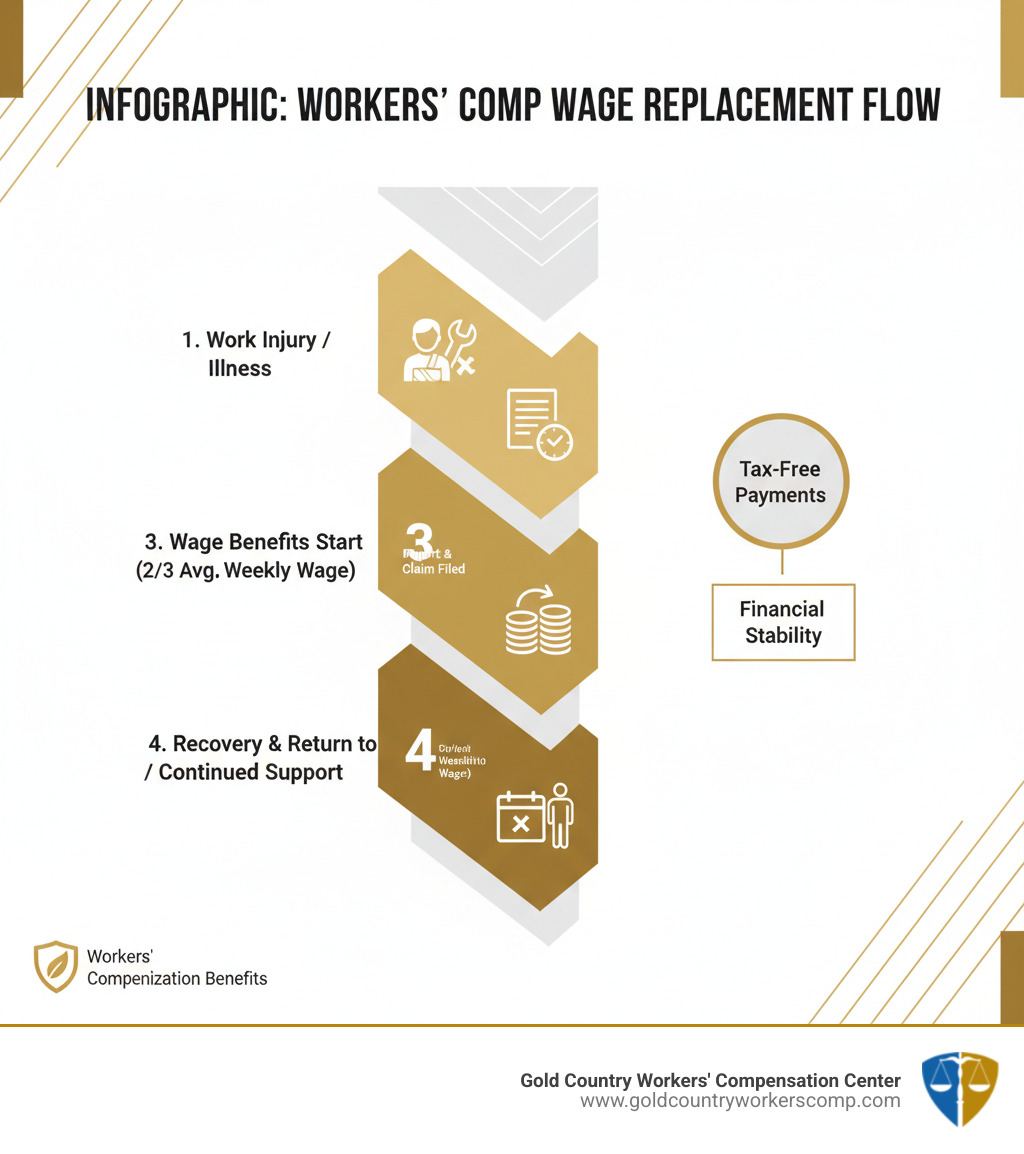
Infographic: Workers' Comp Wage Replacement Flow - workers comp wage replacement infographic

What Are Workers’ Comp Wage Replacement Benefits?

Workers’ compensation is a social insurance program providing a safety net for employees and employers. As a “no-fault” system, it ensures you receive medical care and financial support for a job-related injury without needing to prove who was to blame. The focus is simply on whether the injury is work-related.

Workers’ comp has two main components: medical benefits cover treatment costs like doctor visits and physical therapy, while workers comp wage replacement (or indemnity benefits) helps replace your missing paycheck. While both are vital, wage replacement is what keeps your household running when you can’t work.

To qualify, you must be an employee whose injury or illness is work-related. This includes sudden injuries, like a fall, and conditions that develop over time, like carpal tunnel syndrome. In California, any employer with at least one employee must have workers’ compensation insurance. Reporting your injury to your employer promptly is the crucial first step to starting the claim process.

Safety First Sign - workers comp wage replacement

The Primary Purpose: Financial Support During Recovery

The financial stress of a work injury can be as debilitating as the physical pain. Workers comp wage replacement exists to mitigate this financial burden by helping you cover essential living expenses like rent, utilities, and groceries. A significant advantage is that these benefits are typically non-taxable, meaning the amount you receive is close to your usual take-home pay.

This financial support provides peace of mind. When you aren’t worried about making ends meet, you can focus your energy on what matters most: your recovery.

Who Is Eligible for Wage Replacement?

In California, eligibility for workers comp wage replacement is broad. If you are an employee (full-time, part-time, temporary, or seasonal) and suffer a work-related injury or illness, you are generally covered. This applies to both traumatic injuries (sudden accidents) and repetitive stress injuries that develop over time. California law even protects workers regardless of their immigration status.

However, some common exemptions exist. Federal employees are covered by a separate federal system (FECA). Other exempt groups may include certain agricultural workers, some domestic workers, business owners with no employees, and specific volunteers. If you’re unsure about your eligibility, especially regarding your employment classification, it’s wise to seek professional guidance. The team at Gold Country Workers’ Compensation Center offers consultations at no initial cost to help clarify these situations.

How Are Wage Replacement Benefits Calculated?

Calculating your workers comp wage replacement benefits involves a few key factors. The system is designed to replace a portion of your lost income, not your entire paycheck. The general formula is two-thirds of your average weekly wage. However, this amount is subject to state-mandated maximum and minimum weekly benefit amounts.

These limits are adjusted annually in California to reflect economic changes, influenced by the Statewide Average Weekly Wage (SAWW). This ensures benefits keep some pace with the cost of living. For the most current figures and detailed information, the California Division of Workers’ Compensation (DWC) website is the official resource: https://www.dir.ca.gov/dwc/workerscompensationbenefits.htm.

Calculator and Pay Stubs - workers comp wage replacement

Determining Your Average Weekly Wage (AWW)

The foundation of your benefit calculation is your Average Weekly Wage (AWW). This figure represents your earnings before your injury. To determine your AWW, the insurance company typically reviews your gross earnings (pre-tax pay) from the 52 weeks prior to your injury. This includes not just your regular salary or hourly pay but also overtime, bonuses, and commissions. The goal is to capture a fair representation of your typical income. Adjustments can be made for irregular employment or if you worked for less than a year.

State-Specific Rates and Maximums

The “two-thirds rule” is a general guideline, but specific rates and maximums for workers comp wage replacement vary by state. In California, the rates are adjusted annually.

For example, as of January 1, 2023, the minimum Temporary Total Disability (TTD) rate in California was $242.86 per week, and the maximum TTD rate was $1,619.15 per week. It’s crucial to check the official California DWC website for the latest benefit tables applicable to your date of injury.

To illustrate how states differ, here is a comparison of approximate TTD benefits:

State General Benefit Rate 2023/2024 Maximum Weekly Benefit (approx.)
California 2/3 of AWW $1,619.15 (as of 1/1/2023)
North Carolina 2/3 of AWW $1,184 (2022) / $1,380 (2025 proj.)
New York 2/3 of AWW (adjusted by disability) Varies annually, based on NYSAWW

This table provides approximate figures for comparison. Always confirm the latest rates for your specific injury date and state.

The Four Main Types of Disability Benefits Explained

As you recover from a work injury, you may move through different phases of disability. A crucial milestone is reaching Maximum Medical Improvement (MMI), the point where your condition is considered stable. This often determines whether your disability is temporary or permanent and which of the four main types of workers comp wage replacement you may receive.

Disability Benefit Progression Timeline - workers comp wage replacement

Temporary Disability Benefits (TTD & TPD)

These benefits provide wage replacement while you are actively recovering.

  • Temporary Total Disability (TTD): If your doctor determines you cannot work at all for a temporary period, TTD pays two-thirds of your average weekly wage. These payments continue until you can return to work or reach MMI.
  • Temporary Partial Disability (TPD): If you can return to work in a limited capacity (e.g., light duty) and earn less than before, TPD helps bridge the gap. It typically pays two-thirds of the difference between your pre-injury and current wages.

Permanent Disability Benefits (PPD & PTD)

If your injury results in a lasting impairment after reaching MMI, you may be eligible for permanent disability benefits.

  • Permanent Partial Disability (PPD): This applies when you have a permanent impairment but can still work in some capacity. California uses a comprehensive impairment rating to calculate PPD benefits, compensating you for the long-term loss of function.
  • Permanent Total Disability (PTD): For the most severe cases where an injury permanently prevents you from any gainful employment, PTD benefits are paid. These benefits, which can last for life, are reserved for catastrophic injuries like the loss of limbs or severe brain injuries.

The Role of an Impairment Rating

An impairment rating is a medical assessment that quantifies the extent of your permanent loss of function after you reach Maximum Medical Improvement (MMI). A doctor evaluates your condition, often using the American Medical Association (AMA)’s Guides to the Evaluation of Permanent Impairment, and assigns a percentage of impairment.

This percentage is a key factor in calculating your permanent disability benefits. In California, this rating is called a Whole Person Impairment (WPI) score, which is then adjusted for your occupation and age to determine your final disability rating. You can learn more about this on the DWC workers’ compensation benefits page. If you disagree with your rating, you have the right to challenge it, often by requesting an Independent Medical Examination (IME).

Understanding the process for receiving workers comp wage replacement can make a difficult time more manageable. The journey follows several key steps: reporting the injury, seeking medical care, filing a claim, and, if approved, receiving benefits.

The typical process is as follows:

  1. Report the Incident: Notify your employer immediately after the injury occurs or you realize it’s work-related.
  2. Seek Medical Treatment: A doctor’s evaluation is crucial for documenting your injury and your inability to work.
  3. File a Claim: Complete and submit the necessary forms provided by your employer.
  4. Insurer Investigation: The insurance carrier will review your claim to verify the details.
  5. Claim Approval or Denial: If approved, your benefits will be calculated and disbursed. If denied, you have the right to appeal.

Workers' Compensation Claim Form - workers comp wage replacement

The Waiting Period Before Benefits Begin

Most workers’ compensation systems have a waiting period before wage replacement benefits begin. In California, you typically won’t be paid for the first three days you are unable to work. However, there are important exceptions:

  • The waiting period is waived if you are hospitalized overnight due to the injury.
  • If your disability lasts for more than 14 days, you will be paid retroactively for those first three days.

Once a claim is accepted, you should receive your first payment within 14 days of your employer learning about your disability. Other states have different rules; for example, North Carolina has a 7-day waiting period.

What to Do if Your Workers Comp Wage Replacement is Denied or Disputed

A denied claim or a dispute over your benefit amount can be frustrating, but you have the right to challenge the decision. If your claim is denied in California, you can file an appeal with the Workers’ Compensation Appeals Board (WCAB), the state body that resolves such disputes.

If you disagree with the doctor’s impairment rating, which directly affects your permanent disability benefits, you can request an Independent Medical Examination (IME) for a second opinion. Navigating appeals and disputes can be complex, and seeking legal assistance is often a wise step to protect your rights.

Understanding Settlements: Clincher Agreements

In California, a workers’ compensation claim can be resolved through a settlement, known as a “Compromise and Release” (C&R) or “Stipulations with Request for Award” (Stips). In exchange for a lump-sum payment, you agree to permanently close your claim and waive all future rights to medical care and wage replacement for that injury.

This is a final, binding decision with significant long-term consequences. It is critical to consult with a qualified workers’ compensation attorney before signing any settlement agreement to ensure the offer is fair and your rights are protected.

Beyond direct disability payments, the workers comp wage replacement landscape includes other forms of support that can aid in your recovery and return to work. Understanding how these benefits interact is key to maximizing your support.

Person in vocational training class - workers comp wage replacement

Can You Receive Other Benefits Simultaneously?

Receiving workers comp wage replacement alongside other income or benefits can be complex. Generally, you cannot be paid twice for the same period of lost work.

  • Employer Pay: If your employer continues to pay your full salary, you typically won’t also receive workers’ comp wage replacement.
  • STD/LTD Insurance: Private Short-Term or Long-Term Disability policies usually do not pay out at the same time as workers’ comp for a work-related injury. Workers’ comp is the primary payer, and other benefits may be reduced or offset.
  • Social Security Disability (SSDI): You may qualify for federal SSDI benefits for a long-term disability. However, the Social Security Administration may reduce your SSDI payments if you are also receiving workers’ comp. This “offset” ensures your combined benefits do not exceed a certain percentage of your pre-disability earnings.

Other Financial Support: Vocational Rehab and Travel Expenses

If a permanent injury prevents you from returning to your old job, help is available. In California, you may be eligible for a Supplemental Job Displacement Benefit (SJDB). This is a voucher worth up to $6,000 to be used for education, vocational retraining, or other skill-building services to help you find a new career.

Additionally, you are entitled to reimbursement for reasonable travel expenses for medical treatment related to your work injury. This includes mileage (projected to be around $0.70 per mile in California for 2025), parking, and tolls. Keep detailed records and receipts of all treatment-related travel to ensure you are fully reimbursed. You can find current rates on the DWC workers’ compensation benefits page.

What Are Workers Comp Wage Replacement Death Benefits?

If a work-related injury or illness results in a worker’s death, workers’ compensation provides death benefits to support the surviving family. These benefits offer financial stability during an incredibly difficult time.

In California, death benefits are paid to a surviving spouse, children, or other financial dependents. The total benefit amount depends on the number of dependents, ranging from $250,000 for one dependent to $320,000 for three or more. Payments are typically made weekly at the temporary disability rate. Minor children will continue to receive payments until they turn 18. Additionally, workers’ compensation covers reasonable burial expenses up to $10,000 for injuries after January 1, 2013. Filing these claims involves strict deadlines, so families should seek guidance to secure the support they are entitled to.

Conclusion

We’ve explored the complex world of workers comp wage replacement, from how benefits are calculated to the differences between temporary and permanent disability. It’s clear that while these benefits are a critical financial lifeline, the system itself is intricate. The rules and rates can vary depending on your location in California and the date of your injury.

When you’re facing a work injury, understanding your rights and the benefits available to you is paramount. It empowers you to make informed decisions and focus on your recovery without the added weight of financial stress.

Navigating this system alone can be daunting, but you don’t have to. The specialists at Gold Country Workers’ Compensation Center are here to help. Led by attorneys Kim LaValley and Kyle Adamson, our team offers nearly 50 years of combined experience. We are dedicated to ensuring you receive every benefit you deserve. We believe in getting involved early and offer a no initial consultation fee to provide accessible legal help for injured workers in Roseville, Nevada City, and throughout California. Our goal is to help you achieve a positive outcome and get back on your feet.

For more detailed information on your rights, we encourage you to explore our comprehensive guide on understanding workers’ comp benefits.

Unmasking Coverage: What Workers’ Comp Says About Your Unique Injury

chemical exposure workers compensation

Why Chemical Exposure Workers Compensation Matters for Your Health and Livelihood

Chemical exposure workers compensation provides critical benefits when you suffer illness or injury from hazardous substances at work. Whether you inhaled toxic fumes, absorbed chemicals through your skin, or swallowed contaminated materials, you have legal rights to medical care and financial support.

Quick Answer: What Chemical Exposure Workers Compensation Covers

  • Medical Treatment: 100% coverage for doctor visits, medications, and specialized care related to your chemical exposure
  • Lost Wages: Temporary disability benefits while you recover and can’t work
  • Permanent Disability: Compensation if your exposure causes lasting health problems
  • No-Fault System: You don’t need to prove your employer did anything wrong to receive benefits

Exposure to toxic substances at work is a serious risk. With around 650,000 chemical products in U.S. workplaces, the dangers aren’t always obvious. Some cause immediate harm, while others damage your health slowly over months or years.

You might develop respiratory issues, skin conditions, neurological damage, or even cancer. In 2023 alone, private industry employers reported 2.6 million nonfatal workplace injuries and illnesses, with many tied to chemical exposure.

The workers’ compensation system exists to protect you, but these claims can be complex. Insurance companies may dispute the cause of your illness, and strict legal deadlines can jeopardize your case if you don’t know the rules.

This guide walks you through everything you need to know—from understanding your rights to filing a claim and getting the benefits you deserve. You’ll learn the steps to protect yourself and your family’s financial future.

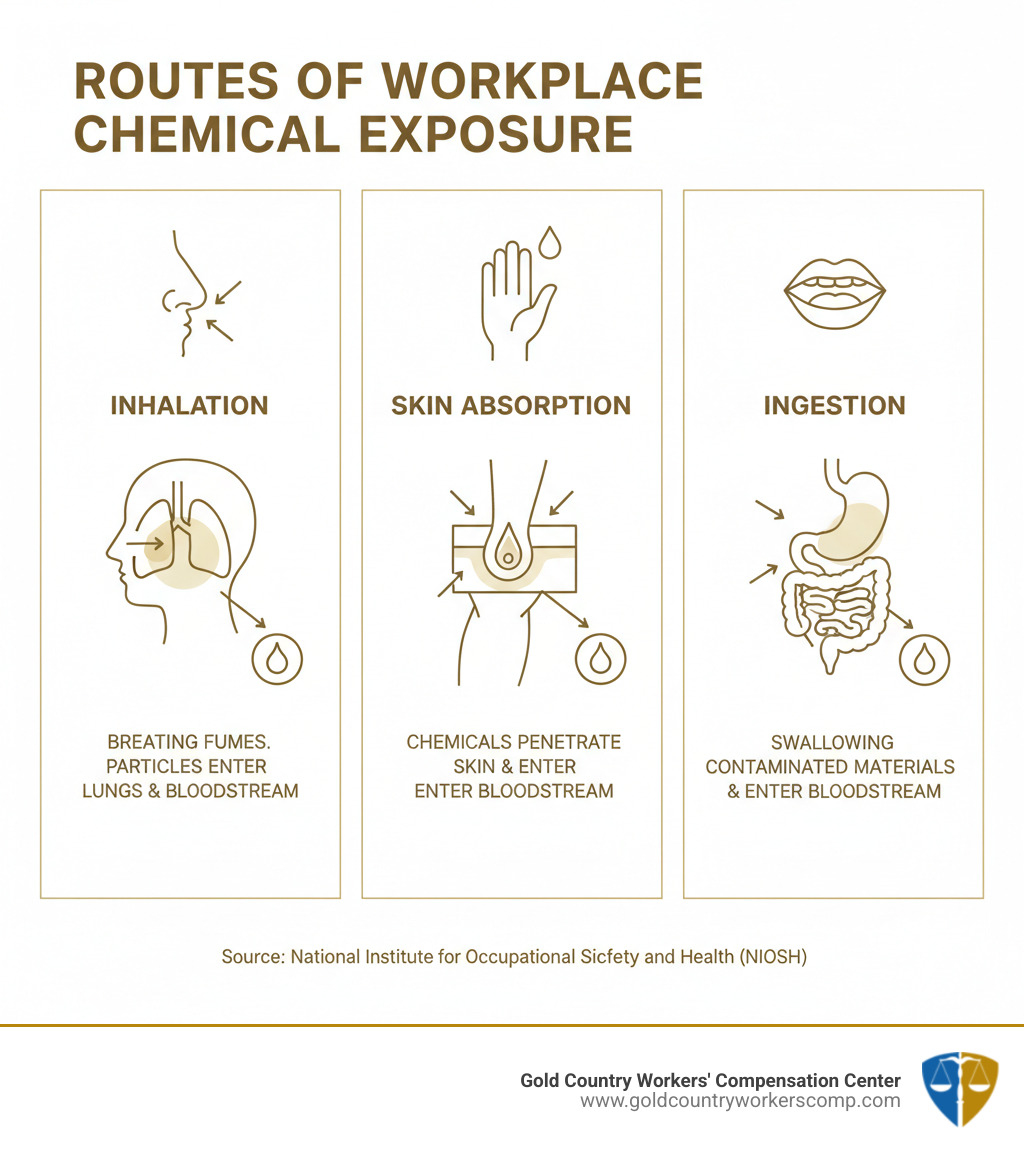
Infographic showing three main routes of chemical exposure in the workplace: inhalation (breathing toxic fumes through nose and mouth with particles entering lungs), skin absorption (chemicals penetrating skin barrier and entering bloodstream), and ingestion (swallowing contaminated materials through mouth). Each route shows simple anatomical diagram with arrows indicating chemical entry points and affected body systems. - chemical exposure workers compensation infographic

Understanding Chemical Exposure and Its Health Impact

While many people think of workplace injuries as sudden accidents, some of the most serious hazards come from chemical exposure. This can happen suddenly, like a chemical spill, or gradually from breathing in dust or fumes day after day.

Both types of exposure can make you seriously ill and qualify you for chemical exposure workers compensation benefits. However, proving that your health problems came from work can be complicated, especially when symptoms don’t appear for months or years.

The real challenge with these claims isn’t getting benefits for an immediate chemical burn. The harder cases involve chronic illnesses—like a construction worker who develops lung disease after years of inhaling silica dust, or a factory employee diagnosed with cancer decades after benzene exposure.

If you’ve suffered an illness from hazardous exposures at work in California, you may be entitled to workers’ compensation benefits, whether the exposure was a single incident or occurred over time.

Various warning labels for hazardous chemicals, including symbols for flammables, corrosives, health hazards, and environmental hazards. - chemical exposure workers compensation

Common Harmful Chemicals Found in the Workplace

After nearly 50 years of helping workers in Grass Valley, Roseville, and Nevada City, we’ve seen how almost any workplace can expose employees to dangerous chemicals. Construction sites, farms, hospitals, auto shops, and even offices can harbor hazardous substances.

  • Asbestos: Found in older buildings, it releases fibers when disturbed that cause lung disease and mesothelioma, often decades later.
  • Benzene: Used in refineries and chemical plants, this liquid can cause blood disorders and increase cancer risk.
  • Lead: A concern in construction and manufacturing, lead damages the nervous system, kidneys, and reproductive organs.
  • Pesticides: A risk for agricultural workers, these can cause immediate respiratory issues and long-term nervous system damage.
  • Solvents: Found in paints, cleaners, and adhesives, they can be inhaled and may damage the neurological system, lungs, and skin over time.
  • Acids: Used in labs and manufacturing, these corrosive substances can cause severe chemical burns on contact.
  • Silica dust: Created when cutting materials like concrete or stone, these tiny particles scar the lungs and cause silicosis, a progressive lung disease.

Your employer has a legal duty to inform you about chemicals in your workplace, but not all employers comply.

How Chemical Exposure Can Affect Your Health

The health effects of chemical exposure vary based on the chemical, the dose, the duration, and your individual health. Some people react severely while others seem fine for years before symptoms emerge.

  • Respiratory diseases: Inhaling toxic fumes, dusts, or gases can lead to asthma, COPD, or lung cancer. A study of respiratory-related workers’ compensation claims in Ohio found over 30% were linked to chemical exposure.
  • Skin conditions: Contact with irritating substances can cause rashes, dermatitis, or severe chemical burns. Some chemicals can also be absorbed through the skin and cause internal damage.
  • Neurological damage: Prolonged exposure to heavy metals or solvents can lead to headaches, memory loss, and permanent brain damage.
  • Cancer: Many workplace chemicals are known carcinogens. Asbestos causes mesothelioma, while benzene is linked to leukemia. These cancers often appear 10 to 30 years after exposure.
  • Organ damage: The liver and kidneys are especially vulnerable as they filter toxins from the body. Severe exposure can lead to organ failure or chronic disease.
  • Blood disorders: Chemicals like benzene can cause anemia and bone marrow damage, which may develop gradually.

Because many of these conditions don’t appear immediately, proving the link between your illness and past workplace exposure requires diligent record-keeping and expert medical opinions. Documenting everything is crucial, even if you feel fine now.

Your Rights and Your Employer’s Responsibilities

California has some of the strongest workplace safety regulations in the country, designed to protect you from toxic chemicals. Understanding these rules helps you spot violations and is essential for a successful chemical exposure workers compensation claim.

What is OSHA’s Role in Regulating Chemical Exposure?

The Occupational Safety and Health Administration (OSHA), and its California counterpart Cal/OSHA, sets the ground rules for chemical safety. Their mission is to keep workers safe from toxic exposures.

  • Permissible Exposure Limits (PELs): OSHA establishes PELs, which are legal ceilings for the amount of a substance allowed in workplace air. Your employer cannot legally expose you to levels exceeding these limits.
  • Hazard Communication Standard: This “Right-to-Know” law requires employers to identify every chemical hazard in the workplace and inform you about them.
  • Employee Training: Your employer must teach you about the chemicals you work with, their dangers, how to protect yourself, and what to do in an emergency.
  • Personal Protective Equipment (PPE): Employers must provide necessary PPE, such as respirators or chemical-resistant gloves, at no cost to you and ensure you use it correctly.
  • Workplace Inspections: OSHA conducts inspections, investigates incidents, and responds to worker complaints, issuing fines for safety violations.

A sample Safety Data Sheet (SDS) with sections like Identification, Hazard(s) Identification, Composition/Information on Ingredients, First-Aid Measures, Fire-Fighting Measures, Accidental Release Measures, Handling and Storage, Exposure Controls/Personal Protection. - chemical exposure workers compensation

California law demands that employers protect workers from chemicals. After nearly 50 years of handling these cases, we’ve seen the devastating results when employers cut corners.

Your employer must:

  • Provide the right safety equipment: This includes chemical-resistant gloves, face protection, or properly fitted respirators appropriate for the specific hazards you face.
  • Ensure proper ventilation: Ventilation systems must be installed and maintained to prevent the buildup of hazardous fumes, dusts, and gases. Strong chemical odors or visible dust clouds are signs of inadequate ventilation.
  • Clearly label all hazardous substances: Labels must identify the contents, hazards, and necessary precautions.
  • Make Safety Data Sheets (SDS) accessible: These detailed documents explain a chemical’s properties, health hazards, and safe handling procedures. You have the right to review them at any time.
  • Provide comprehensive training: You must be trained on chemical hazards, how to read labels and SDSs, how to use PPE, and what to do if an exposure occurs.
  • Monitor exposure levels and maintain records: If monitoring shows concerning exposure levels, your employer must notify you and take corrective action. These records are critical evidence for a future workers’ compensation claim.

When employers fail in these duties and workers get hurt, the workers’ compensation system is there to help you recover.

Chemical exposure workers compensation claims are often more complex than other injury cases. The process can be confusing, especially when insurance companies question whether your illness is work-related. Understanding the steps can make all the difference.

What to Do Immediately After a Chemical Exposure Incident

Acting quickly after a chemical exposure is crucial for your health and your claim. Here are the immediate steps you should take:

  • Get medical help immediately, even if you feel fine. Tell the doctor your injury happened at work to create a medical record linking your condition to your job.
  • Report the incident to your supervisor as soon as possible. California law gives you 30 days, but reporting sooner strengthens your case.
  • Write everything down while it’s fresh in your memory: how, when, and where the exposure occurred; the chemical involved; your symptoms; and any witnesses.
  • Identify the specific chemical if you can do so safely. Look for container labels or ask for the Safety Data Sheet (SDS).
  • Get contact information from any witnesses. Their statements can provide crucial support for your claim.

Steps to File Your Claim and Secure Benefits

After taking immediate action, you must officially file your claim.

Your employer is required to give you a claim form (DWC-1) within one working day of learning about your injury. Fill it out completely, make a copy for your records, and return it to your employer. This officially starts your chemical exposure workers compensation claim.

Once you submit the form, the claims administrator (usually an insurance company) will process your claim. Continue to follow your doctor’s treatment plan and attend all appointments, as your medical records are the backbone of your case. Keep a log of all communications with the insurance company, noting who you spoke with, when, and what was said.

What Benefits Can You Receive?

If your claim is approved, California law provides several key benefits:

  • Medical treatment coverage: Pays 100% of necessary medical care for your work-related exposure, including doctor visits, prescriptions, and specialized treatments.
  • Temporary disability benefits: Replaces a portion of your lost wages if your doctor says you cannot work while recovering.
  • Permanent disability benefits: Provides compensation if the exposure causes lasting health problems that affect your ability to work.
  • Supplemental Job Displacement Benefits (SJDB): A voucher for retraining or skill development if you have permanent work restrictions and cannot return to your old job.

Crucial Documentation for a Chemical Exposure Workers Compensation Claim

Documentation can make or break a claim. The more evidence you have, the harder it is for an insurer to deny it.

  • Medical records: Keep all reports, test results, and bills. They are essential for proving the link between your exposure and your illness.
  • Incident reports: Get copies of any reports filed with your employer or safety officers.
  • Witness statements: Collect written statements or contact information from coworkers who saw what happened.
  • Pay stubs: These help calculate your lost wages and disability benefits accurately.
  • Personal journal: Track your daily symptoms, medical appointments, and communications with your employer or the insurer. This journal is powerful evidence of how the exposure affects your life.
  • Safety Data Sheet (SDS): Obtain the SDS for the chemical involved to support your medical and legal case.

A timeline illustrating the workers' compensation claim filing process, starting from injury, reporting to employer, filing DWC-1 form, medical evaluation, and claim decision. - chemical exposure workers compensation

We know this feels like a lot. That’s why Gold Country Workers’ Comp exists—to help workers like you through this process. With nearly 50 years of experience, we can help you avoid costly mistakes and get the benefits you deserve. There’s no initial consultation fee.

When dealing with a chemical exposure injury, you must understand all your legal options. While chemical exposure workers compensation is your primary path, you may have additional avenues for compensation, especially if a third party is at fault.

California’s no-fault workers’ compensation system means you only need to show the exposure happened at work and caused your illness. This simplifies the process but also limits the damages you can recover. In some situations, a personal injury lawsuit against a third party may also be possible.

Workers’ Compensation Claim vs. a Personal Injury Lawsuit

The difference between these two legal routes is crucial.

  • Workers’ Compensation Claims are part of a no-fault system. You can receive benefits without proving your employer was negligent, which simplifies the process. However, this “exclusive remedy rule” generally prevents you from suing your employer. Benefits cover medical care and lost wages but exclude compensation for pain and suffering.

  • Personal Injury Lawsuits require you to prove that someone’s negligence caused your injury. This is a higher legal bar, but a successful lawsuit can provide more comprehensive damages, including compensation for pain and suffering, emotional distress, and even punitive damages.

There is a rare exception to the exclusive remedy rule: you may be able to sue your employer directly if they intentionally caused your injury.

When a Third Party Is Responsible for Your Exposure

Sometimes, a third party—someone other than your employer or a coworker—shares responsibility for your exposure. In these cases, you can file both a chemical exposure workers compensation claim and a separate personal injury lawsuit against that third party.

Potential third parties include:

  • Chemical manufacturers: Can be held liable if their product was defective or lacked proper warnings.
  • Defective equipment suppliers: The manufacturer of faulty ventilation systems or protective gear that failed to protect you may be responsible.
  • Subcontractors: If a subcontractor on your job site carelessly handled chemicals and exposed you to harm, you can pursue a claim against them.
  • Property owners: If you were working on someone else’s property and they failed to warn you of known chemical hazards, they may be liable.

Filing a third-party lawsuit can significantly increase your total recovery by providing damages not covered by workers’ comp, like pain and suffering. However, your employer’s insurer may have a right to be reimbursed from your third-party recovery, so careful legal strategy is essential.

How a Lawyer Can Assist with Your Claim

The complexity of chemical exposure workers compensation claims makes legal representation invaluable. At Gold Country Workers’ Comp, we’ve spent nearly 50 years helping injured workers in Grass Valley, Nevada City, and throughout California steer these challenging cases.

An experienced lawyer can:

  • Gather crucial evidence: We collect medical records, incident reports, and expert opinions to build a strong case, which is vital for illnesses that appear years after exposure.
  • Steer deadlines: We ensure all paperwork is filed correctly and on time, protecting you from California’s tricky statute of limitations for occupational diseases.
  • Negotiate with insurers: We level the playing field against insurance companies whose goal is to minimize your payout, fighting for the full benefits you deserve.
  • Represent you in appeals: If your claim is denied, we handle the entire Workers’ Compensation Appeals Board (WCAB) process for you.
  • Manage the QME process: We prepare you for Qualified Medical Evaluator (QME) exams and challenge reports that don’t accurately reflect your condition.

Our approach emphasizes early intervention. The sooner we get involved, the better we can protect your rights. We don’t charge for initial consultations, so you can get expert advice without financial risk. Kim LaValley and Kyle Adamson bring decades of combined experience to achieve positive outcomes for injured workers.

You don’t have to face this complex process alone. With the right legal team, you can secure the benefits you need to move forward.

California Workers’ Comp: Don’t Settle for Less, Hire the Best Lawyer

Workers comp lawyer California

A workers comp lawyer California is your key to securing the benefits you deserve after a workplace injury. The system is complex, and insurance companies often try to minimize payouts or deny valid claims.

Key Steps After a Workplace Injury:

  1. Report the injury to your employer immediately (the deadline is 30 days).
  2. Seek medical treatment and keep all records.
  3. File a DWC-1 Claim Form to officially start your claim.
  4. Hire a workers’ comp lawyer if your claim is denied, delayed, or undervalued.

California has a “no-fault” workers’ compensation system, meaning you don’t have to prove your employer was negligent to receive benefits for medical costs and lost wages. However, insurance companies may still dispute your injury or push for a low settlement. Research shows that settlements with attorney representation are typically 40% higher than those without. As one client said, “I felt like family due to the attorney’s responsiveness and guidance.”

An injured worker needs an advocate who can fight insurance companies and steer the legal maze. That’s where a skilled workers comp lawyer California is essential. Whether you have a denied claim or a severe injury, getting legal help early can make all the difference.

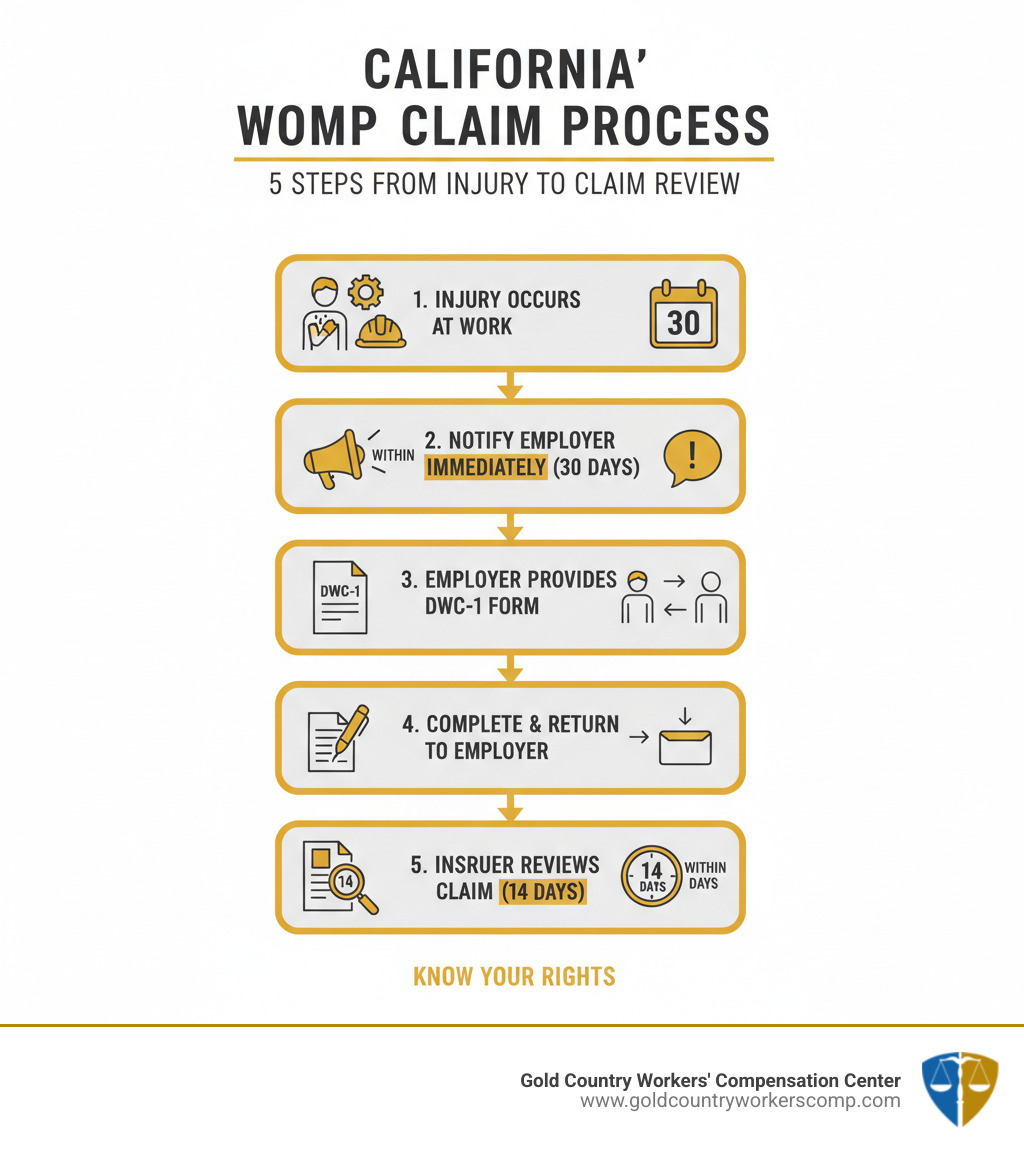
Infographic showing 5 steps from workplace injury to filing a claim in California: 1. Injury occurs at work, 2. Notify your employer immediately (within 30 days), 3. Employer provides DWC-1 Claim Form, 4. Complete and return form to employer, 5. Insurance company reviews claim within 14 days - Workers comp lawyer California infographic

Workers comp lawyer California glossary:

Understanding California’s Workers’ Compensation System

California’s workers’ compensation system is a “no-fault” program, meaning you are covered for an injury sustained while doing your job, regardless of who was at fault. This approach is designed to help you get benefits quickly so you can focus on recovery.

Every California employer with even one employee must carry workers’ compensation insurance. This insurance is your safety net, covering medical treatment, lost wages, and other benefits. The California Department of Industrial Relations oversees the system and provides resources on your rights.

The system covers both sudden on-the-job injuries (like a fall) and occupational illnesses that develop over time (like lung problems from dust exposure). Both scenarios qualify for benefits.

What Types of Injuries Are Covered?

If your injury or illness is job-related, it’s likely covered. This includes a wide range of conditions.

common workplace injuries like back strain and repetitive motion - Workers comp lawyer California

  • Specific injuries: These are sudden, one-time events, like a fall from scaffolding or a severe burn.
  • Cumulative trauma and repetitive stress injuries: These develop slowly from repetitive motions or awkward positions. Examples include carpal tunnel syndrome from typing, shoulder problems from constant reaching, or tendonitis.
  • Back and neck injuries: These are among the most common claims, resulting from lifting, prolonged sitting, or driving. They can range from muscle strains to herniated discs requiring surgery.
  • Psychological stress: Severe anxiety, depression, or PTSD caused by your job can qualify for benefits, though they require strong medical evidence connecting the condition to your work.
  • Chemical exposure: Illnesses from workplace chemicals, whether from a single event or long-term contact, are covered.
  • Aggravation of pre-existing conditions: If your job made a previous injury or condition worse, you are entitled to benefits for that aggravation.

At Gold Country Workers’ Compensation Center, our nearly 50 years of combined experience means we’ve handled almost every type of injury. We know every case is unique and deserves fair compensation.

What Are the Time Limits for Filing a Claim?

Missing a deadline can mean losing your right to benefits. Here are the critical timelines:

You must notify your employer within 30 days of your injury. We recommend doing this in writing immediately. For gradual injuries, the clock starts when you realize the condition is work-related. Waiting gives the insurance company a reason to be skeptical.

After you report the injury, your employer must give you a DWC-1 Claim Form within one working day. This form officially starts your claim.

The second major deadline is the one-year rule: you have one year from the date of injury to file your DWC-1 form. For gradual conditions, this one-year period begins when you first need medical care or realize your condition is work-related.

Missing this deadline is often fatal to a claim. That’s why we urge injured workers in Grass Valley, Nevada City, and Roseville to contact a workers comp lawyer California right away. Our free consultations can ensure you meet all deadlines and file a strong claim from the start.

The 5 Key Benefits You Can Receive

California’s workers’ compensation system provides five key benefits to support you after a work injury.

  1. Medical Care: Covers all reasonable and necessary treatment for your injury, including doctor visits, surgery, prescriptions, physical therapy, and travel expenses for appointments.
  2. Temporary Disability (TD) Benefits: Replaces a portion of your lost wages if your doctor says you cannot work or can only work reduced hours. These benefits typically pay two-thirds of your average weekly wages, up to a legal maximum.
  3. Permanent Disability (PD) Benefits: Provides compensation if your injury has lasting effects that impact your ability to earn a living. The amount depends on your impairment rating, age, and occupation. This is where a workers comp lawyer California is crucial, as proper calculation can mean a difference of thousands of dollars.
  4. Supplemental Job Displacement Benefits (SJDB): If you have a permanent disability and your employer can’t offer modified work, you may receive a voucher (up to $6,000) for retraining or job placement services.
  5. Death Benefits: In the tragic event of a work-related death, these benefits provide financial support to the worker’s dependents, including burial expenses.

While average settlements in California range from $20,000 to $50,000, severe injuries can result in much higher amounts. Our goal is to secure the maximum compensation you are entitled to.

How Are Workers’ Compensation Settlements Determined?

A fair settlement considers your medical condition and future ability to work. The process begins when you reach maximum medical improvement (MMI), the point where your condition has stabilized. At this stage, a doctor assesses any permanent impairment.

If there’s a dispute, a qualified medical evaluator (QME) or an agreed medical evaluator (AME) will provide an independent medical opinion. These reports are critical in determining your permanent disability rating. California uses a complex permanent disability rating schedule to calculate benefits based on your impairment, age, and occupation.

Finally, we begin negotiation with the insurance company. Insurers want to pay as little as possible. An experienced attorney knows their playbook and will fight to protect your interests and maximize your settlement.

What if My Claim is Denied?

A denial notice is not the end of the road. Insurance companies deny claims for many reasons, often hoping you’ll give up.

denial letter from an insurance company - Workers comp lawyer California

Common reasons for denial include claims that the injury isn’t work-related or you missed a deadline. You have the right to appeal by filing an Application for Adjudication of Claim with the Workers’ Compensation Appeals Board (WCAB). This is a formal legal process that requests a hearing before a judge.

Navigating the WCAB without legal help is extremely difficult. The procedures are technical, and the insurance company will have its own lawyers. We handle the entire appeals process, from gathering evidence to representing you at hearings, so you can focus on healing. If your claim was denied, contact a workers comp lawyer California immediately.

The Crucial Role of a Workers Comp Lawyer California

When you’re injured at work, you’re not just dealing with physical pain; you’re also facing a complex legal system. A workers comp lawyer California is your strongest ally, ensuring the system works for you.

Insurance companies have teams of adjusters and lawyers focused on minimizing payouts. They use tactics to delay, devalue, or deny your claim. Without an expert on your side, it’s easy to accept far less than you deserve.

We handle the legal complexities, manage deadlines, and ensure all paperwork is filed correctly. We fight insurance companies on your behalf, protecting your rights at every turn. Most importantly, we work to maximize your compensation. Research shows that workers with legal representation receive significantly higher settlements—often 40% more.

We work on a contingency fee basis, meaning you pay nothing upfront. Our fee comes from the settlement we win for you and is set by California law, so there are no surprises.

When Should I Hire a Workers Comp Lawyer California?

While not every minor injury requires a lawyer, these red flags indicate you need professional legal help:

  • Your claim is denied: This is the clearest sign you need an attorney to file an appeal and fight the denial.
  • Your injury is severe or complex: Catastrophic injuries involve substantial long-term costs that require expert valuation.
  • Your employer disputes your claim: If your employer questions your injury, you need an advocate on your side.
  • You have a pre-existing condition: Insurers often use this as an excuse to deny claims. We know how to prove your job aggravated the condition.
  • Your employer retaliates: If you’re fired, demoted, or punished for filing a claim (a violation of Labor Code 132a), we can help.
  • You’re offered a low settlement: Never accept an offer without having it reviewed. Insurers often make lowball offers hoping you’ll take them.

Even if you’re unsure, a free consultation can provide clarity. Early intervention often leads to better outcomes.

How a Top Workers Comp Lawyer California Helps Your Case

An experienced workers comp lawyer California transforms how your case is handled.

a lawyer compassionately consulting with an injured client - Workers comp lawyer California

  • Case Evaluation: We start by listening to your story and providing honest advice about your rights and options.
  • Gathering Evidence: We collect all necessary medical records, witness statements, and employment documents to build a strong case.
  • Managing Deadlines: We track all critical dates and file all paperwork accurately and on time, so your rights are protected.
  • Representation at Hearings: We represent you before the Workers’ Compensation Appeals Board (WCAB), presenting your case and arguing on your behalf.
  • Negotiating Settlements: We handle all communication with the insurance company, using our experience to negotiate a fair settlement that covers all your needs.

A Certified Specialist in Workers’ Compensation Law brings an even higher level of expertise, having passed rigorous exams and met extensive experience requirements, as the California State Bar explains. At Gold Country Workers’ Compensation Center, we bring nearly 50 years of combined experience to help injured workers in Roseville, Nevada City, and Grass Valley.

Frequently Asked Questions about California Workers’ Comp

With nearly 50 years of experience helping injured workers in California, we’ve answered almost every question. Here are some of the most common ones.

How much does a workers’ comp lawyer cost in California?

Hiring a workers comp lawyer California costs you nothing upfront. We work on a contingency fee basis, which means our payment is a percentage of the settlement or award we win for you. If we don’t recover benefits, you owe us nothing.

There are no upfront costs to hire us; we cover all case expenses. The fee percentage is set by law in California, typically 10% to 15% of your final recovery, and must be approved by a judge. This cost-effective representation often results in clients receiving significantly more compensation, even after fees, than they would have on their own.

Can my employer fire me for filing a workers’ compensation claim?

No. California law protects you from retaliation. Labor Code Section 132a makes it illegal for an employer to fire, demote, cut your hours, or otherwise discriminate against you for filing a workers’ comp claim.

While California is an “at-will” employment state, this does not give employers the right to break anti-discrimination laws. If you are fired shortly after filing a claim, it could be considered wrongful termination. If you suspect this has happened, seeking legal advice immediately is crucial. We can investigate and determine if you have a valid claim against your employer.

How long does a workers’ compensation case take in California?

The timeline for a workers’ comp case varies, ranging from a few months to a couple of years. Several factors influence the duration:

  • Case Complexity: A simple injury with a cooperative insurer may resolve in months. A complex case with disputed facts will take longer.
  • Severity of Injury: Your case can’t fully settle until you reach Maximum Medical Improvement (MMI). Severe injuries require more time for treatment and evaluation before MMI is reached.
  • Insurance Company Cooperation: An uncooperative insurance company that uses delay tactics can significantly extend the timeline.
  • Litigation vs. Settlement: If we can negotiate a fair settlement, the case resolves faster. If we must go to hearings before the WCAB, the process takes longer.

Our priority is not to settle fast, but to secure the full benefits you deserve under California law, keeping you informed every step of the way.

If you’ve been injured at work, you’re facing a confusing system and an insurance company that doesn’t have your best interests at heart. You don’t have to face this alone.

At Gold Country Workers’ Compensation Center, we have spent nearly 50 years fighting for injured workers in Grass Valley, Roseville, and Nevada City. We know the insurance companies’ tactics and how to defeat them.

The value of experienced representation cannot be overstated. With our team, you’re not just a case number; you’re a person who deserves justice. We believe in early intervention, as contacting us soon after your injury allows us to better protect your rights and maximize your compensation.

We offer a no-fee consultation to give you honest answers and a clear path forward, with no obligation. Since we work on a contingency basis, you pay us nothing unless we win your case.

Don’t let an insurance company decide your future. Let us fight for the benefits you are entitled to so you can focus on your recovery.

Learn more about our California workers’ compensation lawyer services and take the first step toward getting the expert legal help you deserve.

Sacramento’s SSD Superstars: Top Lawyers for Your Disability Claim

best social security disability lawyers near me sacramento ca

Why Finding the Right Sacramento SSD Lawyer Could Make or Break Your Claim

Finding the best social security disability lawyers near me sacramento ca can be the difference between approval and denial when a disabling condition prevents you from working. The application process is notoriously complex, denial rates are high, and navigating it alone puts your financial future at risk.

Here’s the reality: more than 60% of initial Social Security Disability applications are denied. This isn’t because most people don’t deserve benefits—it’s because the system is designed to be stringent, technical, and unforgiving of mistakes.

When you’re already struggling with a disability, the last thing you need is to fight a bureaucratic battle alone. A skilled Sacramento disability lawyer knows how to steer these challenges. They understand what local Administrative Law Judges look for, how to develop compelling medical evidence, and how to present your case in a way that gets results. Many experienced attorneys report success rates of 80-90% or higher—dramatically better than going it alone.

Crucially, Social Security Disability attorneys work on contingency, meaning you pay nothing unless you win. The fee is capped by federal law at 25% of your back pay or $7,200, whichever is less.

infographic showing social security disability claims process with 60% initial denial rate, appeal stages including reconsideration, administrative law judge hearing, appeals council, and federal court, with success rates improving at each stage with attorney representation - best social security disability lawyers near me sacramento ca infographic

Best social security disability lawyers near me sacramento ca definitions:

Understanding the SSD Landscape: SSDI vs. SSI

If you’re searching for the best social security disability lawyers near me sacramento ca, understand which program you’re applying for. The Social Security Administration (SSA) runs two main disability programs: Social Security Disability Insurance (SSDI) and Supplemental Security Income (SSI). Both provide financial support, but they have completely different eligibility rules. Applying for the wrong one can cause significant delays or denial.

Key Differences in Eligibility

Think of SSDI as an insurance policy you’ve paid into through Social Security taxes while working. Your eligibility depends on earning enough “work credits.” The number of credits you need is based on your age when your disability began.

SSI is a needs-based program for people with disabilities who have very limited income and resources, regardless of their work history. To qualify, your financial situation must meet strict federal guidelines.

Both programs share a core requirement: your disability must be severe enough to prevent you from performing Substantial Gainful Activity (SGA). This means your condition stops you from doing your previous job or adjusting to other work, and it must be expected to last at least 12 months or result in death.

Which Program is Right for You?

Your work history is the primary factor. If you’ve worked and paid Social Security taxes, SSDI is likely the correct program. If you have limited income and assets, SSI may be the right fit. It’s also possible to qualify for both programs simultaneously, which are known as “concurrent benefits.”

Getting this right on your application is challenging. An experienced lawyer can evaluate your work history, income, and resources to ensure your application is positioned for the best possible outcome from the start.

Criteria Social Security Disability Insurance (SSDI) Supplemental Security Income (SSI)
Funding Source Social Security taxes paid by workers, employers, and self-employed people General tax revenues (not Social Security taxes)
Eligibility Disabled, with sufficient work credits from past employment Disabled, blind, or aged (65+), with limited income and resources
Work History Required (based on age and disability onset) Not required
Financial Need Not based on income/assets (beyond SGA limits) Based on low income and resources
Associated Health Benefits Medicare (after a waiting period) Medicaid (typically immediately upon approval, depending on state)
Benefit Amount Varies based on lifetime average earnings Federally set, can be supplemented by state (e.g., California)
Family Benefits Possible for dependents Generally not available for family members (except eligible spouses)
Typical Applicant Individuals with a work history who can no longer work due to disability Low-income individuals with disabilities, or aged, or blind
Application Process SSA website, phone, or in-person SSA website, phone, or in-person
Appeals Process Reconsideration, ALJ Hearing, Appeals Council, Federal Court Reconsideration, ALJ Hearing, Appeals Council, Federal Court

The Social Security Disability Process in California

The path to getting Social Security Disability benefits in California is a marathon, not a sprint. Understanding the journey ahead—and its common pitfalls—can make all the difference.

The process begins with your initial application, filed online, by phone, or in person. This is where you provide comprehensive details about your medical condition, work history, and daily limitations. After you file, the initial decision typically takes three to six months.

Unfortunately, more than 60% of initial applications are denied. A denial is not the end of the road. It’s the start of the appeals process, which includes several stages:

  1. Reconsideration: A new SSA examiner reviews your case.
  2. Administrative Law Judge (ALJ) Hearing: This is a critical stage where over 50% of claims that reach this level are approved.
  3. Appeals Council: A review of the ALJ’s decision.
  4. Federal Court: The final stage of appeal.

Each stage is another chance to strengthen your case, but it also adds significant time to the process.

flowchart illustrating the social security disability application and appeals process - best social security disability lawyers near me sacramento ca

How Long Does the SSD Process Take in Sacramento?

Patience is essential. While an initial decision takes a few months, the appeals process can stretch the timeline considerably. An ALJ hearing, for example, can add 12 to 18 months or more due to backlogs. From start to finish, a case can take anywhere from several months to over two years.

The key takeaway? Don’t give up after an initial denial. Persistence pays off, especially with an experienced legal guide.

Common Reasons Your Claim Might Be Denied

Understanding why claims are denied can help you avoid common mistakes:

  • Missing medical records: The SSA needs complete, detailed medical evidence from your doctors to approve a claim.
  • Not meeting the definition of disability: The SSA may decide your condition isn’t severe enough or that you could perform other types of work.
  • Earning over the SGA limit: If you’re working and earning more than the Substantial Gainful Activity (SGA) threshold, the SSA will assume you are not disabled.
  • Not following doctor’s orders: Failing to follow prescribed treatment can lead the SSA to believe your condition isn’t as serious as you claim.
  • Application errors: Simple mistakes or incomplete forms can sink your claim before it gets a fair review.

Working with the best social security disability lawyers near me sacramento ca is crucial for avoiding these pitfalls and building a strong case from the start.

How a Top Sacramento Disability Lawyer Can Win Your Case

While the initial 60% denial rate seems daunting, the odds improve dramatically with an experienced disability lawyer. Many attorneys report success rates of 80-90% or higher. This isn’t luck—it’s the result of expertise and strategic case building.

A top Sacramento disability lawyer acts as your advocate and strategic partner. While non-attorney advocates can represent you, a licensed attorney has comprehensive legal training and can represent you at all levels of appeal, including federal court.

Your lawyer will start with a thorough case evaluation, identifying and strengthening potential weaknesses. They handle all communication with the SSA, manage deadlines, and work to maximize your back pay. Most importantly, they represent you at hearings, using their legal knowledge to build a winning case.

The Critical Role of Medical Evidence

The SSA requires objective proof of your disability. A lawyer is invaluable in this area, as they know exactly what kind of medical evidence is needed and how to obtain it. They work with your doctors to develop comprehensive records that paint a complete picture of your condition and its impact on your life.

This includes seeking detailed opinions from your physicians about your specific functional limitations—what you can and cannot do. Your lawyer translates complex medical information into terms the SSA understands, drawing a direct line between your diagnosis, your symptoms, and your inability to work.

For more information on how the SSA evaluates claims, visit the Social Security Administration’s Disability Benefits page.

The ALJ hearing is often the most critical stage of the process and where many cases are won. Your lawyer’s role here is indispensable.

  • Preparation: They will thoroughly prepare you for your testimony, helping you clearly articulate how your disability affects you.
  • Cross-Examination: The ALJ often calls on medical and vocational experts. Your lawyer will cross-examine these experts, challenging opinions that don’t align with your actual limitations.
  • Local Knowledge: Experienced Sacramento attorneys are often familiar with local ALJs and understand what they look for in a successful case.
  • Legal Argument: Your lawyer will present a compelling legal argument, tying all the evidence together to prove you meet the SSA’s strict definition of disability.

lawyer and client reviewing documents in an office setting - best social security disability lawyers near me sacramento ca

Your Checklist for Finding the Best Social Security Disability Lawyers Near Me Sacramento CA

Choosing the right legal partner is critical. When you’re looking for the best social security disability lawyers near me sacramento ca, focus on these key factors to find an advocate who will treat you with respect and fight for your case.

Factor 1: Verifiable Experience and Specialization

In Social Security Disability law, experience is paramount. Look for an attorney with 10+ years of dedicated experience who specializes exclusively in this field. A specialist stays current on all regulations and has a deep understanding of the system. Local Sacramento expertise is also a major advantage, as these lawyers are familiar with the tendencies of local SSA offices and Administrative Law Judges (ALJs).

Factor 2: A Strong Track Record and Positive Reviews

Results matter. A firm with a success rate over 80-90% demonstrates its effectiveness. Beyond statistics, read client testimonials and peer ratings on sites like Justia or Super Lawyers. Look for comments about clear communication, respect, and feeling heard. Positive reviews from both clients and peers are a strong indicator of a trustworthy and effective lawyer.

Factor 3: Understanding the Fee Structure for the best social security disability lawyers near me sacramento ca

Fortunately, you don’t need money upfront to hire a top disability lawyer. Nearly all work on a contingency fee basis, which is regulated by the SSA.

Here’s how it works: you pay nothing unless you win your case. The fee is 25% of your past-due benefits (or “back pay”), capped at $7,200. The SSA pays your attorney directly from your back pay award, so you never have to write a check. If you don’t win, you owe no attorney fees. This system ensures your lawyer is fully motivated to win your case.

At Gold Country Workers’ Comp Center, we’ve spent nearly 50 years helping people in situations just like yours. Our approach emphasizes early intervention and personalized attention, and we never charge for that initial consultation. Based in Grass Valley, just north of Sacramento, Kim LaValley and Kyle Adamson have built their practice on one simple principle: helping people resolve their issues with positive outcomes. If you’re searching for the best social security disability lawyers near me sacramento ca, we invite you to reach out. Let’s talk about your situation and explore how we can help.

Frequently Asked Questions about Sacramento SSD Claims

Navigating the SSD process brings up many questions. Here are answers to some of the most common concerns we hear.

What are the key qualifications for Social Security Disability benefits?

To qualify, you must meet several criteria:

  • Your medical condition must prevent you from performing Substantial Gainful Activity (SGA), meaning you cannot earn above a certain monthly income limit.
  • Your condition must be severe enough to significantly limit basic work activities like sitting, standing, lifting, or remembering.
  • Your disability must have lasted, or be expected to last, for at least 12 continuous months or result in death.
  • For SSDI, you need sufficient work credits from paying Social Security taxes.
  • For SSI, you must have limited income and financial resources.

What are some common disabling conditions that qualify for benefits?

While the diagnosis alone isn’t enough, many conditions can qualify if they are severe enough to prevent work. What matters is the functional limitation caused by the condition. Common examples include:

  • Musculoskeletal issues: Chronic back pain, degenerative disc disease, severe arthritis.
  • Mental health conditions: Severe depression, anxiety, PTSD, bipolar disorder.
  • Cancer: Especially advanced cases or those requiring intensive treatment.
  • Neurological disorders: Multiple sclerosis (MS), Parkinson’s disease, epilepsy, effects of a stroke.
  • Cardiovascular conditions: Congestive heart failure, coronary artery disease.
  • Autoimmune diseases: Lupus, rheumatoid arthritis, Crohn’s disease.

How can a lawyer help find the best social security disability lawyers near me sacramento ca?

This question is often about how a lawyer can help you win your claim. An experienced disability lawyer is your most powerful asset. They help by:

  • Ensuring your application is complete and accurate, avoiding common errors that lead to denial.
  • Gathering crucial medical evidence and working with your doctors to document your limitations effectively.
  • Managing the entire appeals process, from filing for reconsideration to representing you at your ALJ hearing.
  • Building a persuasive legal case by preparing you to testify, cross-examining experts, and arguing on your behalf.

Essentially, a lawyer takes the burden of navigating this complex system off your shoulders, dramatically increasing your chances of success. At firms like Gold Country Workers’ Comp, with nearly 50 years of experience, we fight for you every step of the way.

Conclusion: Take the Next Step Towards Securing Your Benefits

We understand how overwhelming this journey can feel. You’re dealing with a life-changing disability while facing a bureaucratic system that seems designed to say “no.” The high initial denial rate is a real barrier, but it’s one you don’t have to face alone.

The right legal representation can transform your chances. An experienced disability lawyer knows how to build a strong case, steer the appeals process, and advocate for you effectively. Look for a specialist with a proven track record, deep experience, and a commitment to their clients.

Don’t delay your claim. Time is critical. The sooner you get expert help, the sooner you can build a winning case and secure the benefits you need.

At Gold Country Workers’ Compensation Center, we’ve spent nearly 50 years helping people in Roseville, Nevada City, and throughout California. We believe in early intervention and never charge for an initial consultation.

Kim LaValley and Kyle Adamson are here to offer the strength, knowledge, and personalized attention your case deserves. If your claim has been denied or you’re just starting the process, reach out to us. Let’s discuss your situation and how we can help you secure your future.

Sacramento skyline at sunset - best social security disability lawyers near me sacramento ca

Find out more about our disability law firm services and take that first step toward securing your future today.

Injured? Don’t Go It Alone: Finding Your Workers’ Comp Advocate

workers comp lawyers

Why Workers Comp Lawyers Can Make or Break Your Claim

Workers comp lawyers specialize in helping injured employees steer the complex claims process to secure the benefits they deserve. If you’ve been hurt on the job, here’s a quick overview of how a lawyer can help.

When to Hire a Workers Comp Lawyer:

  • Your claim has been denied or disputed
  • You’ve suffered a permanent or disabling injury
  • Your employer retaliates against you for filing
  • The settlement offer seems too low
  • You have a pre-existing condition complicating your claim
  • You’re also applying for Social Security Disability benefits

What They Do:

  • Handle all paperwork and filing deadlines
  • Gather medical evidence to support your claim
  • Negotiate with insurance adjusters
  • Represent you at hearings and appeals
  • Work on contingency (no upfront costs, typically 10-20% of settlement)

Getting hurt at work is stressful enough without the financial pressure of medical bills and lost wages. The workers’ compensation system itself is a maze of forms, deadlines, and insurance adjusters.

Here’s the reality: injured employees who hire a workers’ compensation lawyer receive settlements that are, on average, five times larger than those who go it alone. That’s often the difference between covering your bills and going into debt.

While a lawyer isn’t necessary for every minor injury, professional help is crucial in many situations. This guide will help you understand when you need a workers comp lawyer, what they do, how much they cost, and how to find the right advocate for your case.

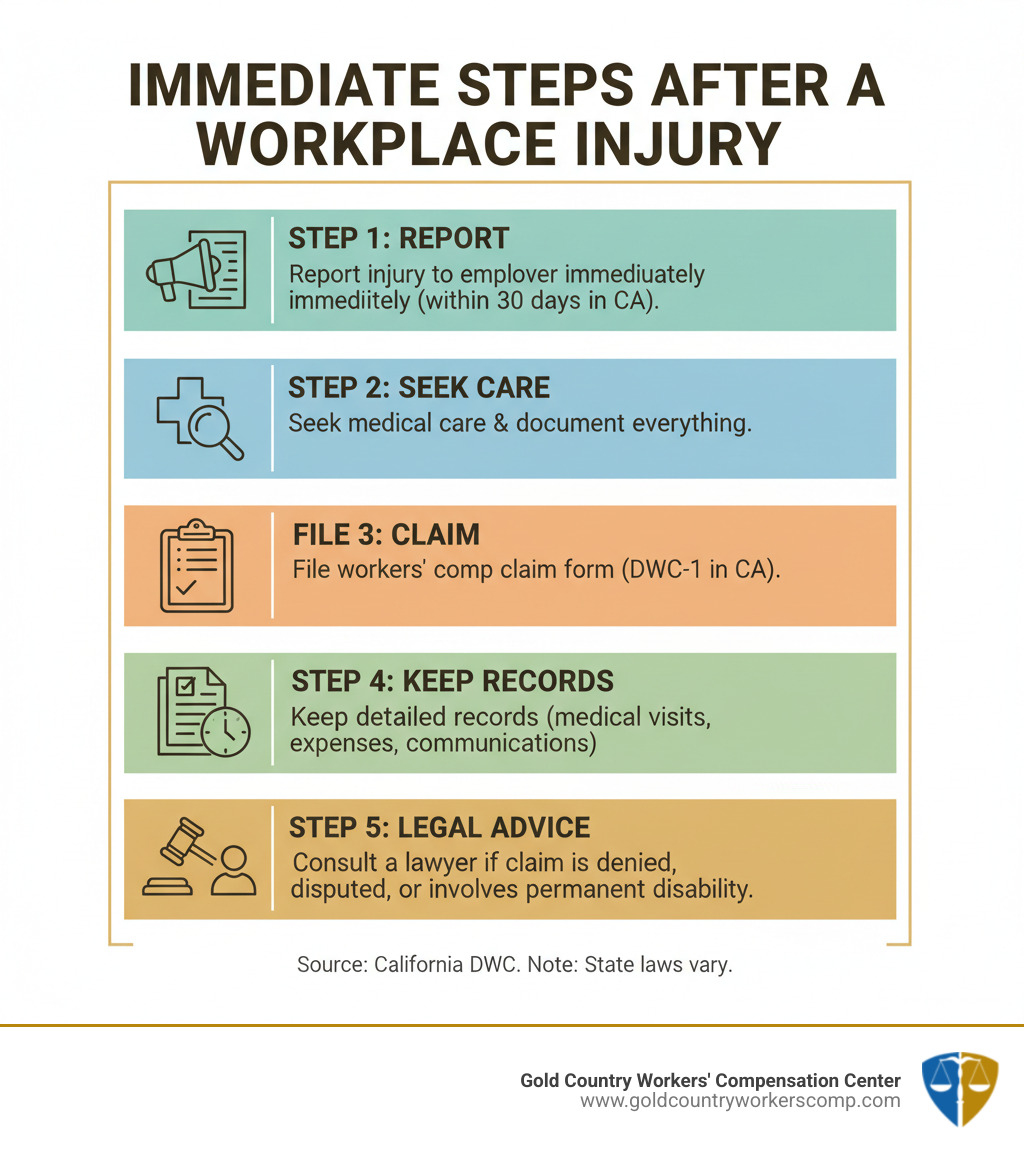
Infographic showing the immediate steps after a workplace injury: Step 1 - Report your injury to your employer immediately (within 30 days in California). Step 2 - Seek medical care and document everything. Step 3 - File a workers' compensation claim form (DWC-1 in California). Step 4 - Keep detailed records of all medical visits, expenses, and communications. Step 5 - Consider consulting a workers comp lawyer if your claim is denied, disputed, or involves permanent disability. - workers comp lawyers infographic

Understanding the Workers’ Compensation System

Workers’ compensation law is a state-run, “no-fault” system that provides a safety net for employees who get hurt or sick because of their job. It provides medical care and wage replacement benefits without you having to sue your employer. In California, the Division of Workers’ Compensation (DWC) oversees the system, and all employers must carry insurance for their employees.

Insurance companies process claims and manage benefits, but their primary goal is to minimize costs. This can lead to valid claims being disputed or denied, which is when having experienced workers comp lawyers becomes critical. The process involves strict deadlines and complex paperwork that can be overwhelming when you’re also dealing with an injury.

Flowchart illustrating the workers' compensation claim process: Injury occurs -> Report to employer (within 30 days) -> Seek medical treatment -> File DWC-1 form -> Employer submits claim to insurer -> Insurer reviews/investigates -> Claim accepted or denied -> If denied, injured worker can appeal -> Appeal process (reconsideration, hearing, appeals board). - workers comp lawyers

What Benefits Are Covered?

As an injured worker in California, you are legally entitled to several types of benefits:

  • Medical care costs: Covers all necessary medical treatment for your work-related injury, including doctor visits, prescriptions, physical therapy, and mileage reimbursement for appointments.
  • Temporary disability benefits: Replaces a portion of your lost wages (typically two-thirds of your average weekly wages) if your doctor says you cannot work while recovering.
  • Permanent disability benefits: Provides compensation if your injury results in a lasting impairment that affects your ability to work. The amount is based on the severity of your disability, age, occupation, and pre-injury earnings.
  • Vocational rehabilitation: A Supplemental Job Displacement Benefit voucher can pay for retraining or skill development if you cannot return to your old job.
  • Death benefits: Provides financial support and burial expenses to dependents if a workplace injury is fatal.

The Typical Claims Process

Understanding the claims process can help you avoid costly mistakes:

  1. Reporting the injury: You must notify your employer within 30 days of the injury or when you realized it was work-related. Do not delay.
  2. Filing a claim form (DWC-1): Your employer provides this form. You have one year from your injury date to file it with the Workers’ Compensation Appeals Board, but it’s best to do so immediately.
  3. The insurer’s investigation: The insurance company has 90 days to investigate your claim. They will gather medical records and may interview witnesses.
  4. Claim acceptance or denial: The insurer will either accept your claim and provide benefits or deny it. Denials are common, even for legitimate injuries.
  5. Appealing a denial: If your claim is rejected, you have the right to appeal. This complex legal process involves hearings before a judge, and it’s where workers comp lawyers can turn a denial into an approval.

The Pros and Cons of Hiring a Workers’ Compensation Lawyer

Deciding whether to hire a workers comp lawyer is a significant choice. While legal representation can dramatically improve your claim’s outcome, it’s important to weigh the advantages and potential drawbacks.

This table compares handling a claim yourself versus working with a lawyer:

Feature Handling a Claim Yourself Handling a Claim With a Lawyer
Claim Complexity Often overwhelming, prone to errors Expert navigation, reduced stress
Settlement Amount Likely lower (injured employees who hire a lawyer receive 5x more payout) Higher potential payout
Paperwork & Deadlines Easy to miss, leading to denials Handled by legal team, ensuring compliance
Medical Evidence May struggle to gather sufficient support Lawyers assist in obtaining comprehensive medical documentation
Insurance Negotiation Often at a disadvantage against experienced adjusters Lawyer negotiates aggressively on your behalf
Employer Relationship May remain intact for minor claims Could become strained, but lawyer protects against retaliation
Time Investment Significant personal time and effort Minimal personal time needed for legal processes
Cost No lawyer fees (but potentially lower benefits) Contingency fees (typically 10-20% of settlement), no upfront cost
Peace of Mind High stress, uncertainty Reduced stress, confidence in expert handling

Workers comp lawyers provide several key advantages:

  • Higher Settlements: Research shows that injured employees with a lawyer receive, on average, five times more in their settlements. Experienced lawyers know what your claim is worth and how to fight for it. You can read the study here: Better chance of higher settlement.
  • Expert Navigation: A lawyer ensures all paperwork is filed correctly and on time, avoiding common errors that lead to denials.
  • Stronger Medical Evidence: Lawyers work with trusted medical experts to provide independent evaluations that strengthen your case and document your injuries in a way insurers can’t ignore.
  • Leveling the Playing Field: Insurance companies have teams of professionals working to minimize payouts. Your lawyer acts as your dedicated advocate, putting you on equal footing.
  • Peace of Mind: You can focus on your recovery while your legal team handles the stress of the claims process.

Potential Drawbacks to Consider

It’s also important to be aware of the following considerations:

  • Contingency Fee: Lawyers are paid a percentage of your settlement (typically 10-15% in California), which must be approved by a judge. There are no upfront costs, but a portion of your final award goes to your attorney. Even after fees, represented workers often come out significantly ahead.
  • Claim Timeline: The legal process can be more formal and may extend the timeline of your claim, especially if it goes to a hearing. However, this extra time often leads to a much better outcome.
  • Employer Relationships: While retaliation is illegal, hiring a lawyer can sometimes create tension with an employer. Your health and financial security, however, must come first.
  • No Guarantee of Success: While legal representation dramatically increases your chances of a favorable outcome, no lawyer can guarantee a specific result. What we can promise is to fight for all the benefits you are entitled to receive.

When You Absolutely Need to Hire Workers Comp Lawyers

While not every minor workplace injury requires legal help, many situations that seem simple can quickly become complex. By the time you realize you’re in over your head, you may have already made mistakes that jeopardize your case. Early intervention from workers comp lawyers makes all the difference.

Image of a denied claim letter with "Claim Denied" prominently displayed. - workers comp lawyers

Critical Scenarios for Hiring Workers Comp Lawyers

Here are the red flags indicating you need to hire a lawyer. Trying to handle these situations alone puts your benefits at serious risk.

  • Your claim is denied. A denial is the insurance company’s official refusal to pay. A lawyer can analyze the denial, gather evidence to overturn it, and fight for you through the appeals process.
  • Your employer disputes the injury. If your employer claims your injury didn’t happen at work, you face an uphill battle. Proving the connection requires detailed evidence that a lawyer can help compile.
  • You have a pre-existing condition. Insurers often use pre-existing conditions to deny claims, arguing your pain is from an old injury. A lawyer can prove that the work injury aggravated the condition, entitling you to benefits.
  • You suffer a permanent disability. These complex cases involve long-term medical needs and reduced earning capacity. An attorney is essential to calculate the true value of your claim and secure a fair settlement.
  • Your employer retaliates against you. If you are fired, demoted, or harassed for filing a claim, you need immediate legal protection. A lawyer can protect your job and pursue additional legal action for the illegal retaliation.
  • You are offered a settlement. Initial settlement offers are almost always too low. An attorney can review any offer, negotiate for a fair amount, and ensure it covers all your future needs before you sign away your rights.
  • You receive or plan to apply for Social Security Disability. A workers’ comp settlement can reduce your Social Security Disability (SSDI) benefits. A lawyer can structure the settlement to protect both sources of income.

If your case involves any of these issues, you should consult with workers comp lawyers. With our no-cost initial consultation, there’s no risk in getting an expert opinion.

How a Lawyer Can Help and What It Costs

When you’re injured, your focus should be on healing. As your workers comp lawyers, our role is to handle the legal heavy lifting so you can concentrate on recovery.

Image of a lawyer consulting with a client, pointing to documents on a desk. - workers comp lawyers

What Does a Workers’ Comp Lawyer Do for You?

Think of a lawyer as your advocate and shield. We step in to manage the confusing and intimidating workers’ comp system for you.

  • Gathering medical evidence: We collect all your medical records and can arrange for independent medical examinations to build the strongest possible case.
  • Communicating with the insurance adjuster: We handle all communication with the insurer, protecting you from their tactics and ensuring your voice is heard.
  • Negotiating a settlement: We calculate the true value of your claim, including future needs, and negotiate for maximum compensation. While recent data from the Bureau of Labor Statistics (BLS) shows an average settlement around $20,000, we fight for a result that reflects your specific situation.
  • Representing you at hearings: If your claim is denied or disputed, we represent you before a Workers’ Compensation Judge, presenting evidence and making legal arguments on your behalf.
  • Protecting your rights: We ensure you get proper medical care, prevent employer retaliation, and see that the system treats you fairly.

How Do Workers Comp Lawyers Charge for Their Services?

We know that when you’re injured and out of work, you can’t afford legal bills. That’s why workers comp lawyers in California work on a contingency fee basis.

This means you pay no upfront costs. We only get paid if we win your case and recover benefits for you. Our fee is a percentage of your settlement or award, typically between 10% and 15% in California. This fee must be approved by a Workers’ Compensation Judge, which protects you from excessive charges.

If we don’t win your case, you owe us nothing. We cover the initial costs of your case, like filing fees and obtaining records, which are reimbursed from the settlement only if we win.

Considering that represented workers often receive significantly higher settlements, the value is clear. Even after the fee, you are likely to come out far ahead of where you would be on your own.

Frequently Asked Questions about Workers’ Comp

Here are answers to some of the most common questions we hear from injured workers.

Can I be fired for filing a workers’ comp claim?

No, it is absolutely illegal for an employer to retaliate against you for filing a workers’ compensation claim. This includes firing, demotion, cutting your hours, harassment, or any other form of discrimination. This protection is a fundamental right.

If you suspect your employer is retaliating, contact workers comp lawyers immediately. We can document the retaliation and take legal action to protect your rights and your job. You may be entitled to additional damages for illegal retaliation.

How long do I have to file a workers’ compensation claim in California?

Missing a deadline can mean losing your right to benefits. In California, there are two critical time limits:

  1. Report your injury to your employer within 30 days. The clock starts from the date of injury or from when you reasonably should have known your injury was work-related.
  2. File an official DWC-1 claim form within one year of the injury date. Your employer should give you this form, but it is your responsibility to ensure it gets filed with the Workers’ Compensation Appeals Board.

An attorney can ensure all deadlines are met so you don’t lose your rights.

Can I choose my own doctor?

This is a complex issue. Your ability to choose your own doctor in California depends on several factors:

  • Predesignation: If you designated your personal physician in writing to your employer before the injury, you can usually see that doctor.
  • Medical Provider Network (MPN): If your employer has an MPN, you will likely need to choose a doctor from within that network. You have the right to change doctors within the MPN if you are unhappy with your care.
  • Health Care Organization (HCO): If you enrolled in an HCO, you must use their doctors.

Insurance companies often use these rules to steer you toward doctors who may not have your best interests at heart. An experienced workers comp lawyer can clarify your rights and help you get the quality medical care you deserve.

Understanding the workers’ compensation system is one thing; successfully navigating it is another. You don’t have to do this alone. Adding the stress of fighting insurance adjusters and filing complex paperwork to your recovery can slow your healing.

That’s where we come in. At Gold Country Workers’ Comp, Kim LaValley and Kyle Adamson have spent nearly 50 years helping injured workers in Grass Valley, Roseville, and Nevada City get the benefits they deserve. We know how to protect your rights and maximize your recovery.

We believe in early intervention. The sooner you contact us, the better we can prevent costly mistakes. We offer a no initial consultation fee, so you can understand your options without financial risk. This allows us to resolve cases more cost-effectively and successfully.

We are more than just workers comp lawyers; we are advocates who care about the people we serve. The decisions you make now will affect your health and finances for years. Don’t leave your future to chance.

If you’ve been injured at work, reach out for a free consultation. Let us put our decades of experience to work for you.

Find your Sacramento workers comp lawyer and take the first step toward protecting your future today.